

For Week Ending September 11, 2026
Publishing News
Has The Copyright Office Started Scanning Books for AI?
According to Peter DeHaan on AuthorMedia.social, the U.S. Copyright Office told him this week that "some of the text in this work may have been generated by an artificial intelligence ('AI') program." He says he wrote the book. He filed the application in March 2026. He first called the notice a rejection. A later comment on that same thread says he sent one sentence that tracked the Office's proofreading option and received approval in less than 2 hours. The certificate, he wrote, still takes 6 to 8 weeks.
The same first sentence hit Krisan Marotta on July 17 2026.
The letter is examination correspondence. It tells the applicant that copyright requires a human author, that AI-generated text stays outside the claim even after "numerous and/or complex prompts," and that the Office wants a limitation statement excluding "text generated by artificial intelligence" if a program produced any of the deposit.
Marotta spent 2 hours on a detailed reply. The Office sent an immediate follow-up with three boxes: a.) The program generated a new version from a prompt such as "replace my vocabulary with advanced English" or "rewrite in a humorous style." b.) The program made substantial modifications or revisions to entire sentences, "such as line editing to improve readability and consistency." c.) The program served "solely for proofreading to correct the spelling, punctuation, and/or grammar of your original text."
She answered, "Option C best describes my use." Peter used that map this week and cleared the flag the same day. Krisan got her copyright registration in the mail a few days later.
Author Update contacted the Copyright Office before this episode and received the following guidance: use the standard form for registering your copyright; check the correct boxes for AI use, whether it be spellcheck, illustrations, or whatever; a human specialist will review the work and decide whether it contains AI content; an email will be sent to the author attempting to register the work; and the author can clarify why AI might have been detected by the specialist and work out the issue.
The Official Rules Behind the Letter
The March 16 2023 registration guidance already requires applicants to disclose more than a de minimis amount of AI-generated material and to describe the human contribution. Register Shira Perlmutter told the Senate on May 12 2026 that the Office had registered more than 7,000 claims that include disclaimed AI material. Part 2 of the AI report, dated January 29 2025, repeats that prompts alone rarely create authorship and that assistive use leaves human expression protectable.
Registration processing times for claims closed October 1 2025 through March 31 2026 average 4.1 months after the October 1 through November 12 2025 lapse of appropriations. Claims that draw correspondence average 6.3 months on eService. Peter's March filing and September letter sit inside that correspondence window.
The Office has not published the name of any detector, the number of literary claims that receive this letter, or an error rate on human deposits. "Based on our examination" is the phrase in the template.
Legal Analysis
According to the D.C. Circuit in Thaler v. Perlmutter, 130 F.4th 1039 (2025), "the human authorship requirement does not prohibit copyrighting work that was made by or with the assistance of artificial intelligence." The author must be "the person who created, operated, or used artificial intelligence," not the machine. The Supreme Court denied certiorari on March 2 2026.
That sentence is the quote people remember. The case itself was narrower. Thaler listed the machine as sole author and disclaimed human creativity. The court refused that claim and left the "how much AI is too much" line for another day.
The Office told the Supreme Court the same thing in its opposition brief: it "does not refuse to register works based solely on a human author's use of AI." It registered hundreds of works that incorporate AI-generated material between March 2023 and January 2025. Perlmutter's May 12 2026 testimony put that number above 7,000 once the AI portion was disclaimed.
Where the Office is stricter than the D.C. Circuit's dicta: 88 Fed. Reg. 16,190 and Part 2 of the AI report (Jan 29 2025). Prompts alone, even hundreds of them, usually do not make the user the author of the output. AI-generated expression must be disclaimed if it is more than de minimis. That line is in front of a Colorado judge in Allen v. Perlmutter (Jason Allen, Midjourney, 600+ prompts, Théâtre D'opéra Spatial). No ruling yet as of this week.
Peter and Krisan's letter tracks that guidance. The Office asked whether a program generated some of the text. It offered to register the human remainder. Both authors answered option C and received full certificates. That sequence matches "human can use a tool and still register." It does not match "the Office bans AI-assisted books."
What to Do This Week
Reply inside 45 days. Paste the full THREAD ID, brackets included, in the body. Match the Office's a/b/c menu to the facts of the book. Proofreading-only use maps to option c in current Office language. Save the sent email.
Sources:
- US Copyright Office Rejection | AuthorMedia.social (Peter DeHaan)
- The US Copyright Office thinks I'm A.I. | AuthorMedia.social (Krisan Marotta, July 17 2026)
- Copyright Registration Guidance: Works Containing Material Generated by Artificial Intelligence (March 16 2023)
- Copyright and Artificial Intelligence hub, U.S. Copyright Office
- Compendium of U.S. Copyright Office Practices, Chapter 600
- Circular 19: Communication from the Copyright Office
- Registration Processing Times FAQ (claims closed October 1 2025–March 31 2026)
- Testimony of Register Shira Perlmutter, Senate Judiciary IP Subcommittee, May 12 2026
- Nora Scheland, Copyright Office public affairs
Commentary
Jonathan: I called the Office just before the show. I was not expecting to reach them, since it's 9/11 and I figured they'd be closed, but a nice lady picked up and we talked it through.
Thomas: So this isn't the Copyright Office scanning for AI, according to the lady at the office. This is just responding to which boxes you checked in the form. Do I understand that correctly?
Jonathan: She said the specialist was actually checking it for AI, because I tried to make that distinction. I said, “You have a human specialists checking tens of thousands of books a week? Almost no office uses human specialists for every submission.” And she said, “Well, we do.”
Thomas: There's this misnomer that if you use AI to help generate a work, it can't be copyrighted. We've covered this extensively. It is not true according to the D.C. Circuit. And when the Supreme Court had the chance for certiorari, they denied it, letting the Circuit Court ruling stand.
The case itself was very narrow. It was over whether AI could own a copyright, and the case law there is clear. Only humans or legal persons can own copyrights. Animals and machines cannot. But as long as you claim authorship, you can own the copyright. And here's the deal. I don't think the Copyright Office has the authority to reject you if you state, "I wrote this myself." How do they know?
Jonathan: It's subjective. It's the honor system.
Thomas: Many humans write in a really robotic way, and many AIs write in a really human way. I don't know how the Copyright Office navigates that, or what the benefit is, when the bad actors will just say, "Yeah, it's 100% human. I didn't use any AI."
What is the Office going to say? How do they prove it? Where's the burden of proof? We need some laws on this. We need more direction from the federal government.
If the Copyright Office keeps getting more aggressive trying to police AI, which they do not have the authority to do, this is a bureaucracy trying to give itself authority, and that's not how you get authority. Authority is given from the people to the federal government, and then the federal government gives authority to agencies. That is how our country works.
Jonathan: But they're granting a copyright, which is their stamp on it. If a lot of it is AI-generated, they can't give the copyright to an AI entity.
Thomas: But they can give it to a human. That's a legal issue. As long as a human is filing for the copyright, I don't see how they have authority to act as traffic cop.
Jonathan: I think it has to do with the product they're providing. At least in their mind, they want to make sure they're not watering down their thing. Although I've never heard of copyright mattering based on whether something was AI-generated or not.
Thomas: It matters now, more than ever, because people are getting paid.
Jonathan: In the Anthropic settlement.
Thomas: And it also protects you from an AI imposter, someone copying your stuff and claiming to be you.
Jonathan: You know what it might be? They're being pinged with a hundred bot-generated works so people can cash in on the next class-action suit. So they send an email to prompt a human response. You have to check these boxes, like the "click here to prove you're human" thing.
Thomas: Maybe. And maybe that's what the $60 pays for, a human to read it over. You have somebody at $20 an hour looking at it for an hour, plus overhead.
I don't recommend lying to a government agency, but I don't see what would stop a bad actor from doing it. The easy way out is to just say you used AI for spellcheck, and then they approve it.
First-Half Trad Pub Sales Cleared Inflation by 0.4 Points

According to Jim Milliot in Publishers Weekly on September 9, the 1,416 houses that report to the Association of American Publishers StatShot program posted a 3.9% revenue gain for the first half of 2026. The same day's official AAP June StatShot release puts that half at $5.6 billion and June at $936.3 million, up 11.0% from June 2025. Trade, the consumer-book bucket authors live in, rose 3.8% to $4.6 billion.
The Inflation Test
The Bureau of Labor Statistics printed June CPI-U at 3.5% year over year, with the all-items index at 333.952. That is the clean yardstick for a first-half that ends in June. Stack the 3.9% industry gain against that 3.5% CPI and trad publishing cleared four-tenths of a point in real dollars, about $21 million of purchasing-power growth on a $5.6 billion base. Trade's 3.8% leaves 0.3 points, about $13 million.
June did the work. An 11.0% month against a 3.5% CPI is a 7.5-point real surge, about $61 million of inflation-adjusted gain in 30 days. May CPI had run 4.2%, the hottest 12-month reading of the half. Core CPI, all items less food and energy, ran 2.6% through June. Against that core print the 3.9% headline clears by 1.3 points.
Jane Friedman on September 10 rounded the same AAP half to 4% and pointed at fiction and audio as the drivers.
Where the Real Dollars Landed
Milliot's category split puts adult fiction up 8.2% for the half and 19.3% in June. That June spike rode Allen Levi's Theo of Golden, the October 2025 Atria edition, which Circana BookScan credited with more than 55,000 copies in that window. Milliot's July 9 Circana recap had already logged 1,197,952 print copies for the title through the first half. An 8.2% fiction gain against a 3.5% CPI is 4.7 points of real growth.
Adult nonfiction fell 3.5% for the half after a 7.1% June bounce. That is a 7-point hole versus the same CPI. Children's and YA fiction rose 2.6% for the half, 0.9 points behind inflation. Children's and YA nonfiction jumped 24.3%.
On the AAP format table, trade paperbacks rose 8.5% to $1.7 billion, a 5-point real gain. Trade hardbacks slipped 0.8% to $1.5 billion, a 4.3-point real decline. Digital audio rose 12.6% to $597.8 million, a 9.1-point real gain, and now sits above trade ebooks at $516.1 million, down 3.0%. Milliot's adult-only cut puts digital audio at $530.9 million, up 14.7%, and adult ebooks at $444.2 million, down 2.5%.
Religious presses rose 1.6% to $413.6 million. Education materials rose 3.4% to $796.2 million. Professional and scholarly rose 1.7% to $199.1 million. University press sales, in the PW cut, rose 9.6% for the half.
Why Authors Care
A 3.9% headline that clears a 3.5% CPI is a real gain on paper and a rounding error in the checking account. Advances, print runs, and royalty pools move with real dollars. Fiction, trade paper, and digital audio are the formats that beat the CPI. Nonfiction, hardbacks, and ebooks gave ground in real terms.
One backlist-turned-frontlist novel, Theo of Golden, is carrying a visible share of the adult-fiction print. Category fiction still needs more than one lightning title to hold a real-dollar lead into the fall. Audio now out-earns ebooks inside the AAP trade table. A 2026 launch plan that treats the audiobook as a sequel is leaving the faster real-growth format on the table.
What to Do This Week
Price the next book against a 3.5% yardstick, not last year's invoice. If you write adult fiction, keep a paperback and an audio edition in the same season as the hardcover. If you write adult nonfiction, treat a flat advance as a real cut and tighten the hook before you shop the proposal. If you already control audio rights, spend the week getting a 2026 edition into the channel that grew 12.6%.
Sources:
- Jim Milliot, Publishers Weekly, "Publishing Industry Sales Up in First Half of 2026," September 9, 2026
- AAP, "June 2026 StatShot Report: Overall Publishing Industry Up 11.0% for the Month of June, and Up 3.9% Year-To-Date," September 9, 2026
- Jim Milliot, Publishers Weekly, "Print Book Sales Flat in First Half of 2026," July 9, 2026
- Jane Friedman, "Book sales update: American Association of Publishers," September 10, 2026
- BLS The Economics Daily, "Consumer prices up 3.5 percent over the year ended June 2026," July 17, 2026
- BLS, Consumer Price Index — June 2026, USDL-26-1191, July 14, 2026
- BLS The Economics Daily, "Consumer prices up 4.2 percent over the year ended May 2026," June 17, 2026
Commentary
Thomas: This is not 4% growth. This is 0.4% growth for the half year. Annualize that and it comes out to about 0.8%. Less than 1% growth is still very flat. We keep covering versions of this story. Last week we covered the 2025 numbers, which were within a rounding error of inflation. Now traditional publishing is officially surpassing inflation for the six-month window. Good for them.
Indie publishing, on the other hand, is posting double-digit percentage growth, and even adjusted for inflation, it's still significant compounding growth year over year.
To be clear, when we say adult fiction we mean all fiction for adults. It's not a euphemism. It differentiates from middle grade or YA. Your cozy Christian romance, your mystery thriller suspense, all of that is adult fiction. I wanted to be real clear.
The ebook market, I think, is eventually going to get fully conquered by the indies. A traditionally published book is often priced at $15 for the ebook, and it just doesn't move copies. Most traditional houses have given up on making ebook a significant format.
The Nonfiction Book Market Is Collapsing

According to Sean deLone in Dear Head of Mine on September 8, 2026, the nonfiction book market has collapsed across the past decade. The wider industry, in his telling, boomed in Covid and then stayed roughly flat. Fiction and nonfiction flipped places on the hardcover bestseller list he uses as a proxy.
The Inversion
In 2015, 6 of the top 25 bestselling hardcover books were fiction. In 2025, 18 of the top 25 were fiction, which left 7 nonfiction titles.
DeLone, an editor writing for other editors, treats that flip as a business problem. Houses used to treat nonfiction as the stable side of the list. Diet, war, presidency, platform: demand looked predictable. Proposals often ran 30 to 120 pages, and the check bought stature. Novelists got paid to revise a finished manuscript.
That floor is gone. Platform no longer converts on cue. His example is Bunnie Xo, with 2 million Instagram followers and a book he places as the third-bestselling nonfiction hardcover of the year, without household-name fame behind it.
He puts the larger force on demand. A publisher, he writes, will risk an unknown novelist for a return that can run 4 times as high. Two weeks before the essay, the entire hardcover nonfiction bestseller list sold 42,000 copies. The top two fiction hardcovers that same week, The Calamity Club in week 15 and Yesteryear in week 19, sold 52,000. He says one first-week novel could clear the whole nonfiction list.
The Trust Problem
Fiction readership, on his figures, runs about 80% women. Nonfiction sits nearer 50-50. Of the 2025 top 25 nonfiction bestsellers, 8 were by women, 2 by organizations (Guinness World Records and the New York Times), and 15 by men. He ties the category's slide to the crisis of men, then widens the frame. Nonfiction is where gender parity still exists in the audience, so the drop is a social problem.
He uses Gallup's October 2, 2025 media-trust poll as the proxy. Great deal or fair amount of trust sat at 28%, down from 40% five years earlier. "None at all" rose from 24% of respondents to 34%. Readers who dropped newspapers, in his argument, dropped the authority claim of the nonfiction book next.
The Midlist Bellwether
He judges the industry by the midlist. Last year looked less literary and less serious on both sides of the aisle. Literary work, he writes, measures how much challenge a reader will accept: the 800-page biography reader against the 291-page reheated popular history. The 2025 nonfiction list, on his read, ran on political books, celebrity properties, Guinness, and New York Times Puzzle Mania!. He names 2026 signs of life in literary memoir such as Strangers and in Patrick Radden Keefe and David Sedaris, then calls the year silly anyway.
Where the Money Goes
The tide going out on nonfiction sales and reading is entirely reshaping the power balance in the industry, he writes. Money is moving toward fiction. Fiction is harder for a corporation to forecast. It is also harder for a handful of talent agencies to bottle, which is how Big 5 houses used to lock up celebrity nonfiction. Indie presses almost never land those celebrity books. Fiction writers can sell millions with a couple thousand Instagram followers. One structural change he flags is celebrities migrating into novels. He jokes about a Ryan Gosling short-story collection, then footnotes that the celebrity novels will come from duller famous people.
Escapist fiction is the present counterweight. The longer risk, in his close, is the book as a cultural object. If nonfiction carried the authority of the form, that authority is slipping. Cool the fiction boom and the reader base underneath looks thinner than it did a decade ago. He promises a follow-up with ideas for a nonfiction revival.
Why Authors Care
A nonfiction advance used to buy platform. DeLone says platform now fails as a sales machine unless the reader already trusts the person. Follower count is a weak forecast. Bunnie Xo's 2 million Instagram followers still need a reason to buy.
Houses will spend like novel-scouts if a first-week fiction title can beat an entire nonfiction list. Literary midlist nonfiction is the tell for whether readers will sit with difficulty. A puzzle book on the top 25 is the other tell. Fiction writers with almost no public face are taking share that celebrity proposals used to own.
Sources:
- Sean deLone, Dear Head of Mine: The Nonfiction Book Market is Collapsing (September 8, 2026)
- New York Times Hardcover Fiction bestseller list, August 30, 2026
- Gallup: Trust in Media at New Low of 28% in U.S. (October 2, 2025)
- Sean deLone: What is a Midlist Book?
- Bunnie Xo, Wikipedia
Commentary
Thomas: Many people are writing nonfiction, and a lot of the overall industry numbers that look bad are because nonfiction is struggling year after year. We're just not seeing the kinds of nonfiction hits we saw in previous years.
There's a cultural zeitgeist angle, but there's also a technical AI angle. For some books, the question the reader was going to the book to answer, they were Googling 10 years ago, and now they're going to ChatGPT. ChatGPT gives you a customized answer. Some kinds of questions are better answered by AI.
Nonfiction authors now have more financial incentive in creating courses and AI tools that help with nonfiction topics than in creating nonfiction books.
Jonathan: For instance, your most recent episode on setting up your own Grok Bot. You wouldn't write a book on that. You can make a course, but then you can converse with your Grok Bot to figure out how to make updating your website much more manageable.
Thomas: Or even a course. Grok Bot is a perfect example. Some things now move so quickly that neither books nor courses make sense.
I’m going to be teaching a Grok Bot webinar that's cutting edge. It won't be useful a year later, but it'll be useful immediately.
By the time you got a book on Grok Bot proofread, it's already out of date, because they're releasing new features every day right now.
But there's a bigger issue. Publishing boards for major publishers are dominated by women, and historically nonfiction has been 50-50 men and women. There have been lots of good-selling nonfiction books on nerdy topics that only appeal to men, and those books by men and for men are really hard to get published in this current age.
So you want to write a book about Emperor Justinian of the Byzantine Empire. You take it through a pub board, and the women say, "Nobody wants that," because they don't know a single person who wants to read a whole book about General Belisarius and the Nika riots. But the editor and the male author say, "We promise you there's a market for this book." It's not women. It'll be 90% men who want to buy this nonfiction book about the Nika riots.
That book would have been approved 20 years ago, published 20 years ago, and sold mostly to men. Now a lot of those books just don't get approved, or they get female editors trying to adapt them to appeal to women. But it's a book about a general. Watering it down doesn't make it better and doesn't help it sell more copies. It makes it less appealing to the really nerdy guys who care about Belisarius's reconquest of Italy.
Thomas: Sean deLone’s breakdown on Substack talked about the gender breakdown too. Publishing has a problem: it's failing to make products that appeal to men. Men are moving over to podcasting, because it’s one of the few areas where men can create content for other men without women telling them what they can and cannot say.
There's no committee with women in it that you have to appeal to.
If Joe Rogan wants to talk about protein shakes and working out in the gym with another dude, and it's completely boring to women, that's okay, because his audience is just men, and it's a very popular podcast. There's no equivalent in publishing. There are lots of publishers that only publish for women, but I don't know of any nonfiction publishers that only publish for men. It used to be a thing.
There is a real untapped market for male-oriented books in nerdy niches. "This is a book about tanks in World War II, and we're going to break down the Panzer II and the Panzer II A." There's a market for that kind of nonfiction, but you have to get it through the committee.
Jonathan: You have to know what men like to fight about, usually over beers. If you can have somebody arguing about the kinds of rivets the Germans used to hold the tracks on, which is why they didn't work in Russia, then you know the niche you're going for.
Thomas: This is a story we'll continue to follow. There's still a lot of demand for nonfiction, still a lot of people reading it. I think this is a market opportunity for writing the kind of opinionated nonfiction that people want to write. I actually have an episode in the works on how to write nonfiction that will resonate and sell in this age of AI. Spoiler: the secret is Aristotle. He wrote a book on how to write persuasive nonfiction, and if you go back to his principles, your nonfiction will do really well.
One other thing driving these numbers: back in 2020, the hottest nonfiction was political books. You had White Fragility, a lot of DEI-type books, books on the right, the Obamas writing books. The nonfiction charts were dominated by nonfiction. The appeal of left-leaning nonfiction has fallen almost to zero, and the appeal for right-leaning nonfiction has dropped about 80%. And when I say left and right, I don't mean it has leftist themes. I mean overtly political books by political people.
We have an election coming up in a couple months. Can you name a political book everyone's talking about? I can't. We have an entire election cycle going on and there's no political book everyone's talking about. The best-selling one is probably the JD Vance book, and that made waves because he went on The View to promote it, not for the book itself. More people are talking about his baby than his book.
People are fatigued on politics, and the publishing apparatus hasn't found a replacement topic. There were whole publishers geared around making political books, and I feel bad for them, because the winds of culture have shifted and nobody on either side of the aisle wants to read political books anymore, partly because we get it so fast online. If you want quick, you have Twitter. If you want in-depth, you have podcasts. If you want something in the middle, you have YouTube. There's no room for a book that comes out six months later about that topic.
Jonathan: I'm going to make a prediction, and I could be wrong, but I think nonfiction will move toward interpersonal relationships, dating, family, and parenting books.
Thomas: That'll be a big one. You can fix dating. Abigail Shrier has a book coming out on dating that I think may be a smash hit, like her book Bad Therapy. Every time I look at the conversation about the marriage market being broken and young people not getting married, I think, "Oh, I wrote a book on this." But I'm resisting the temptation to jump into the conversation. I would have to cut something from my life.
The Fight Over Anthropic's Claim Settlement Has Begun

According to Jane Friedman's The Bottom Line for Thursday, September 10, 2026, disagreements among authors, agents, and publishers over the Anthropic settlement now feel worse than the industry expected. The public lede on that piece states that the firms administering the settlement married data from multiple databases, and the result is confusion over who counts as a legitimate claimant.
What Happened
JND Legal Administration sent claim notices to every claimant by September 4, 2026. Each notice lists the other parties who filed on the same title and the percentage each party claimed. The official settlement FAQ still prices the pot at approximately $3,000 per work, plus interest, minus court-approved fees and costs, then splits that pot among the legal and beneficial owners of that title. After the July 20, 2026 fee cut to about $101.56 million, Courtney Milan's per-work math landed near $3,127. Trade titles still in print default to a 50-50 author-publisher split. Educational works get no default. Self-published titles and titles with rights back in the author's hands can claim 100 percent.
Publishers Lunch reported on September 4 from class counsel's status report: the first check window is November 1 through November 15, and it covers only works where every rightsholder agrees and payment information sits on file. That first installment is about $2,203.56 per title after fees, service awards, and expenses. Anthropic has $1.05 billion in escrow plus nearly $25 million in interest. The last $450 million plus interest is due by September 27, 2027. The same Lunch report states the parties agreed that the two law-firm appeals over legal fees will leave rightsholder payments on schedule. What holds a title is an unresolved split among co-claimants.
The Fights Inside the Portal
The Authors Guild's September 4 guidance walks through the screenshots. A notice that says every claimant agrees can still be wrong. If you filed for 100 percent and the summary shows a 50-50 default, call JND at 1-877-206-2314 or email info@anthropiccopyrightsettlement.com the same day.
Common collision points: a publisher claims 50 percent or 100 percent on a title the author believes reverted; an educational publisher skips the 50-50 default and claims the inverse of the royalty rate, so a 10 percent royalty becomes a 90 percent publisher claim; an agent line appears at 15 percent; and metadata from an old contract or an old imprint puts a house on a book it no longer controls.
Victoria Strauss at Writer Beware on September 4 has been logging the publisher-side errors: 100 percent claims on reverted novels, 50 percent claims on imprints that shut years ago, and Wiley treating For Dummies titles as Education Works. Some houses, including Kensington, told Jim Milliot at Publishers Weekly on September 9 they mistyped the percentage and are correcting to 50-50. Guild CEO Mary Rasenberger told PW that lawyers put issues on fewer than 25 percent of claims, and that most of those are typos. Real contract fights still go to the administrator, then to the Special Master.
Agents
The Guild's position is blunt. Agents are not rights owners and are not legal claimants entitled to a check from the administrator. If an agent wants a commission, that money comes from the author under the agency agreement. Many of the agent lines authors now see in the portal look like publisher or metadata leftovers. Contact the agent, confirm the intent, and zero the line unless you mean to share. Rasenberger told PW the same rule: you have to be a rights holder to file.
Reversion and the August 10, 2022 Line
The Guild's rule of thumb: rights that reverted before August 10, 2022, the download date in the settlement, support a 100 percent author claim, depending on the contract. Rights that reverted after that date can leave the publisher a valid slice, and the author side then sits at 50 percent on a trade title.
Courtney Milan's September 3 thread tells authors what to upload: a reversion letter first, then royalty statements, Amazon publisher screenshots, a missing listing on the old house's site, or a notarized statement of when and why the rights came back. Ask your agent for the letter. Houses often mailed it there.
The Self-Published Co-Author Bug
On September 8, Milan flagged a software bug that hits self-published or reverted books with more than one author. Pick "default," and the portal invents a silent publisher and parks 50 percent in empty space. Two co-authors then see 25 percent each. The notice will not mark that as a disagreement. Every rightsholder has to open the undisputed section, switch that title to "alternate," type the real percentages, and upload a short Word file that says there is no publisher. The portal rejects the same filename on a second title, so each book needs its own document.
What Authors Do This Week
The settlement gives co-claimants about 30 days after notice to meet, confer, and amend. The Guild states the consequence in one line: unless the co-claimants reach an agreement, funds for that work will not be released. After 30 days the administrator steps in. After that, a court-appointed Special Master decides at no cost to the claimants, with no right of appeal.
Log into the portal from the notice and confirm payment details and address. Update every wrong allocation and upload the contract or the reversion letter. Call the other claimant this week, because a phone call now beats a Special Master later. Zero phantom agent lines after you talk to the agent. Self-published co-authors should hunt the silent-publisher 50 percent even on "no disagreement" titles. Educational authors can use the Textbook and Academic Authors Association as the specialist track, because those contracts often assign the copyright outright. If a notice is missing, check spam, then JND at 1-877-206-2314 or info@anthropiccopyrightsettlement.com. Guild members can also file a legal help request.
Sources:
- Jane Friedman, The Bottom Line: Disagreements in the Anthropic Settlement Were Inevitable, But It Feels Worse Than Expected (September 10, 2026)
- Authors Guild: Important Information Regarding Anthropic Copyright Settlement Claim Notices (September 4, 2026)
- Authors Guild: How to File a Claim in the Anthropic Settlement
- Authors Guild: Court Grants Final Approval of $1.5 Billion Anthropic Copyright Settlement (July 21, 2026)
- Writer Beware / Victoria Strauss: Publishers Are Making Incorrect Claims on Authors' Payouts (September 4, 2026)
- Anthropic Copyright Settlement: Frequently Asked Questions
- Anthropic Copyright Settlement: Options and Due Dates
- Publishers Lunch: Widespread Problems as Authors Receive Anthropic Settlement Notices (September 4, 2026)
- Jim Milliot, Publishers Weekly: Authors Guild Addresses Anthropic Settlement Concerns (September 9, 2026)
- Courtney Milan on deer.social: rights reversion and publisher claims Q&A (September 3, 2026)
- Courtney Milan on deer.social: self-published multi-author allocation bug (September 8, 2026)
- Textbook and Academic Authors Association
- Authors Guild legal help request form
Commentary
Thomas: Speaking of enemies and drama, the fight over the Anthropic claim settlement has begun. It's a billion-dollar bucket of money, and people are getting testy over who gets what and how to split it. Jane Friedman at The Bottom Line had a really great analysis.
Jonathan: You guys ever had someone rich die in your family? You remember what that fight was like afterward? It's like that.
Thomas: It's worse, because of bad metadata. I have an episode on metadata and why it's important. It's not my most popular episode, but it's the one I talk about the most, because beginning authors don't know what metadata is or why it matters. People don't start learning about metadata until they make expensive mistakes and their whole life is falling apart, and they finally think, "I should learn what the word metadata means."
Here's an example why. For settling the money, the lawyers got the list of books by ISBN number, pulled the ISBN metadata on who the publisher and author were, and split the money according to what the metadata said. The problem is the metadata was messy. Sometimes literary agents were listed as the author. Sometimes the author was listed as the publisher. Sometimes the publisher was listed as still being the publisher even though the rights had reverted. And when there are multiple publishers and multiple authors, how do you split the money? You fight.
Jane Friedman has example after example of the different ways it's getting complicated. The Authors Guild has some guidance.
There was some good news, though, for authors who don't have disputed claims. If you're an indie author in the settlement and you're both the publisher and the author, there's no dispute. It's clearly going to you, and you could get your check as soon as November. So you're potentially within eight weeks of getting a check. That's really good news. If you're indie-published and in the settlement, you could be getting $3,000 per book that was in the settlement.
Jonathan: $2,200 after fees.
Thomas: $2,200 after fees. $3,000 once all the piglets at the trough get their bite. That's not including the split with the publisher.
Jonathan: Or the taxes you get to pay.
Thomas: You are going to have to pay taxes on these, because it's not a personal injury, which would be exempt. The other drama is over whether literary agents get money, and literary agents were not part of the class. So officially they don't get a bite of the apple. But they're finding ways, and there's a legitimate way and an illegitimate way. I'm saying this as a former literary agent. The illegitimate way is claiming you should get some because you're the agent. The money is not coming through the contract, so the agent shouldn't get any of it, and just insisting is not the way.
The legitimate way is saying, "Hey, author, this is a lot of work. I'll handle all the paperwork, authorize me to interact and fight for your percentage and file everything for you, in exchange for my normal 15%. Or you can do it on your own." Then the author chooses. A lot of authors would rather the agent take 15% and not have to mess with anything, and then the agent is earning their commission. That's totally fine if the author is given the option. What's not fine is the agent insisting, or not telling the author they could do it themselves by going to the Anthropic settlement website.
Final piece of advice. If you're in the settlement, look up whether you have a disputed claim, and come to an arrangement within the first 30 days with the other people in the claim. If you have a publisher and you decide on 50-50, you need a meeting of the minds, because if you can't sort it out yourselves, you're not going to get paid.
Jonathan: It will get sorted for you, and you will never get paid.
Thomas: It will get sorted for you eventually, when they get around to it, down the road.
Jonathan: Handle this fight and lose some money if you need to.
Thomas: This payout is not adjusted for inflation. $2,200 in November and $2,200 five years from now is not the same money. It won't buy the same number of eggs. Fighting for a few extra percentages at the cost of years of waiting is probably not worth it. The best way is to contact the other people in the settlement. Jane Friedman had example after example of it just being messy metadata, so you have to get ahold of whoever and get them to agree, "Yeah, I shouldn't have been on there, I don't know why I was." They may have to send a letter.
I do have a tool in the Patron Toolbox called Not a Lawyer that can educate you on legal matters, help you know what questions to ask, look over contracts, and define terms. It's not a lawyer and doesn't replace one, but it can educate you so that when you talk to a lawyer you can ask educated questions they can answer quickly. When you're spending $350 an hour, having them explain the basics is not a good use of your money.
Author Alerts
Publishers Want AI for Them, Not for You
Author Update has been warning authors that AI wouldn't just change how books are written, it would change how publishers decide which books get discovered, marketed, and pushed. Now we have the receipts. Publishers Weekly's Fall 2026 AI for Publishing Bootcamp is teaching publishing professionals to build exactly the systems we've been talking about: AI visibility scorecards that measure whether books appear in ChatGPT recommendations, agents that rewrite metadata for better AI discovery, 60-minute AI-powered launch plans, and a Backlist Triage Agent that analyzes sales and metadata every Monday and identifies the 20 books worth attention. Executives from Zon Publishing, Authors Equity, Bonnier Books UK, and The Stable Book Group are demonstrating these workflows live.
This is no longer speculation about where publishing might be headed; it's evidence of where publishers are already going. Author Update has repeatedly argued that authors need to understand AI discovery, optimize their own metadata, and build AI-assisted marketing systems rather than assume their publisher will do it for them. Publishers are now learning to use AI to determine what gets surfaced and supported. The question for authors is simple: if your publisher's AI decides which 20 books deserve attention this week, will yours be one of them?
Commentary
Thomas: Most publishers still insist that authors write their own books, but they are not anti-AI for themselves. This is where traditional authors are really put at a disadvantage, because indie authors get to be the publisher and use AI as much as they want. It's very hypocritical for a traditional publisher to say, "AI for me, but not for thee." But it is what it is.
Novel Marketing Conference

The Novel Marketing Conference is hands-on book marketing, not a typical writers conference. It runs January 22-23, 2027 at the Fickett Center in Austin, Texas. You leave with a written plan to sell more books while spending less time on marketing, with writers groups, interactive workshops, and faculty including Thomas Umstattd Jr. Super tickets sold out. 18 standard tickets remain. Get yours at NovelMarketingConference.com.
Teen Reading Hits Worst Level Since 2000

According to the OECD's Tuesday, September 8 PISA 2025 press release, 760,000 15-year-olds across 91 countries posted the lowest OECD-average reading scores since testing began in 2000 after a 28-point drop from 2015 to 2025, about 1.5 years of learning. OECD Secretary-General Mathias Cormann told Reuters that more screen time and less reading for pleasure have gone hand in hand with weaker results, the line an X post by @Polymarket carried that morning. Authors who write for teens now sell into a market where the average OECD 15-year-old already spends 3.4 weekday hours on leisure screens, so the book that still wins that hour is the one that builds the next reader.
Commentary
Thomas: If you dig into these numbers, where it's really fallen off is books for boys. Publishers aren't making books for boys, they're making books for kids, and this lack of gendered targeting is the result.
Because the publishing industry is dominated by women, they're making books for kids and teens that lean toward the female reader, and the nerdy boy who's really interested in a specific topic is having a harder time finding what he'd want to read.
I'm seeing this at the bookstore. I look at the young adult books and none of them are the kinds of books I liked to read as a young adult. I couldn't find any choose-your-own-adventure books. I couldn't find any books that looked violent. They were all so soft and gentle and about feelings and emotions.
Jonathan: They all became friends in the end.
Thomas: These boys watch movies and play video games. If you want to write something they want to read, there has to be something that appeals to them, or they'll check out. And once they've checked out, they often check out for the rest of their life. Once somebody stops being a reader, they rarely become one again. It happens, but it's very rare. The candle of reading must be kept alight, and publishers have to do a better job creating male-oriented fiction, which means allowing men to make decisions and allowing men to get published.
Jonathan: This is already happening in the video game industry, which was considered so hardened to losing male gamers. Then Marvel's Wolverine came out this past week, and all the guys are like, "I don't want to play this," because they feminized Wolverine. They made all the typically attractive mutants ugly. His script lines are weird, and even the reviewers who are paid to say good things about these games are saying it was okay. That's all they're getting out of it, and they're losing gamers. How do you get a gamer to turn off the system? There's no game they want to play.
Now contrast that with Borderlands. They released an attractive skin for a new character, and all the guys are like, "We are so back." It's unseemly how excited they are, and the entire gamer base is moving over there. Why am I bringing up video games? Because losing gamers was considered impossible five years ago. Call of Duty has been releasing the same game for 20 years.
Thomas: There's this sense in a storm of latent electrical energy. I heard a story about a guy who was struck by lightning, and right before it hit, he could feel this buzzing around him, like the ions were starting to align. I'm feeling that in the air among young men, because there's so little fiction, whether books, movies, or games, really made for them, and so little messaging targeted at them, that it's like this latent energy.
It only takes one person to stick a metal golf club up in the air, and lightning strikes that person. I've been in the publishing industry a long time. My entire career has been in and among authors, and there's never been a time with this much latent electrical energy, where somebody could have lightning in a bottle if they would just ignore the women. And not to say everybody needs to do that, because then there'd be latent energy for writing for women. Understand what I'm saying: there's an unmet, frantic, desperate need of "please make something for me," and if you do, unapologetically, you'll have lightning in a bottle.
If you don't do it, this is my big concern, this latent energy could be used for very terrible things. When you have a million unemployed young men who nobody seems to want, you only need one person to say, "I want you. Let's go take over and change everything. Let's burn it down and build something new," and suddenly everything's burned down and something is built new. Young men are historically the most willing to use violence to accomplish their ends. This is not revolutionary. This is obvious.
Jonathan: For instance, Rome. Rome had a bunch of young men they weren't doing anything with. What did they do with that?
Thomas: Rome had struggling young men on their borders who said, "It's really tough out here on the steppe, we're on the border of starvation. There's all these soft Romans who are weak, and they don't defend their stuff, their women, their crops. Why don't we just steal their crops and their women and their money?" So they get on their horses, ride into Rome, steal a bunch of stuff, and ride back. This is the story over and over again, and it was young men doing it.
As authors, your stories are what help people make sense of the world. If you're not helping them make good sense of it, somebody else's evil story may, because this lightning will strike. It won't dissipate. If there's electrical energy in the cloud, it's going to strike somewhere, and we get to determine where.
Newsom Signs AI Auditor Bills the Labs Backed
According to a September 9 press release from Governor Gavin Newsom, Newsom signed Senate Bill 813 from Sen. Jerry McNerney and Assembly Bill 1405 from Asm. Rebecca Bauer-Kahan on Wednesday, September 9, a first-in-the-nation framework for independent verification organizations that assess AI systems for state-law compliance plus a state registry of AI auditors. Bloomberg Government reports the SB 813 program is voluntary, with Government Operations Agency criteria for those verification organizations due by 2028, and Gizmodo plus Politico report Anthropic endorsed the bills in August while OpenAI posted support the same day through Chris Lehane; an X post by @Polymarket on Thursday led with that lab backing. Authors should watch the referee more than the rulebook, because the labs that can staff compliance teams helped write the audit market smaller model shops and author-tool builders will pay to enter.
Sources:
- Governor of California, September 9, 2026
- SB 813 bill text, California Legislature
- Bloomberg Government, Tran Nguyen, September 10, 2026
- Gizmodo, September 9, 2026
- Politico, Christine Mui, September 9, 2026
- OpenAI, Chris Lehane, "The AI policy window is open," September 9, 2026
- X post by @Polymarket, September 10, 2026
Commentary
Thomas: Ladies, find a man who loves you as much as the big AI labs love regulation. They are desperate to be regulated. Regulation is not what you think. It doesn't hurt who you think, and it doesn't benefit who you think. It's all a shell game.
The Episode for Authors Whose Bodies Fight the Deadline
According to the Christian Publishing Show episode published September 8, 2026, Thomas Umstattd Jr. sat down with Glenna Marshall for How to Keep Writing When Your Body Won't Cooperate. Marshall, author of Praying in Pain: How to Know You're Heard When You Haven't Been Healed, has published 6 books while living with a rare autoimmune disease for 16 years, and she told Thomas that on a 6-month contract she writes at a pace that banks a 6-week buffer because nearly every manuscript costs her weeks when her brain or her body keeps her off the chair. Authors who write through chronic illness should press play on that episode this week and copy the buffer before the next flare eats the deadline.
Sources:
- Christian Publishing Show: How to Keep Writing When Your Body Won't Cooperate (September 8, 2026)
- Praying in Pain: How to Know You're Heard When You Haven't Been Healed (Amazon)
- Glenna Marshall, My Books
Commentary
Thomas: I had a really cool episode come out this week on the Christian Publishing Show about writing through chronic illness. I have two episodes planned. One is about how to get healthy, and the other, which has already come out, is what you do if you can't get healthy but you still want to write. I had a guest on who wrote through terrible health challenges, and I've gotten really wonderful feedback. Author Update gives me all kinds of complicated feedback, but this episode did not.
So, if you or an author you know is struggling with chronic health issues with no obvious cure, but you still want to be a successful author, I encourage you to check out that episode.
Compendium Consolidator Merges Series Bibles

According to Thomas Umstattd's Friday, September 11, 2026 post in the AuthorMedia.social AI space, Compendium Consolidator is live for Novel Marketing patrons at $10 and above. Authors upload the per-book files from Character Compendium, Location Compendium, Faction Compendium, and Creatures & Plants Compendium, and the tool returns one series bible with every entry carried forward, later reveals written into the earlier entries they change, and conflicts flagged for the author to settle. Series writers who already run those four tools book by book can feed the stack in now and hand the merged file to a narrator, an editor, or the next book's run when the series grows.
Sources:
- New Tool: Compendium Consolidator (AuthorMedia.social, Thomas Umstattd, Sept 11, 2026)
- Compendium Consolidator (Patron Toolbox)
- Character Compendium
- Location Compendium
- Faction Compendium
- Creatures & Plants Compendium
Commentary
Jonathan: Criticus Maximus asks, "I used the Patron Toolbox app to help me make a back cover blurb. It seems much better than the one I wrote. I plan to use it. Am I a bad person?"
Thomas: The purpose of marketing copy is to get people to buy your book, and authors generally don't write the marketing copy on their books. Traditionally published authors often can't even write it. So this is a completely white-hat use of AI, and I haven't heard anyone give a rebuttal to that. All the tools in the Patron Toolbox follow the Authors Guild's guidelines on AI use. It's just giving you feedback. Any edits to your book you have to make yourself. There's no watermarking, no AI writing it for you. It's mostly marketing work.
Let's go into it right now, because I have a new Toolbox tool to announce, and it's a perfect example. It's called the Compendium Consolidator. I have a tool that creates a compendium of all the characters in your book, the main characters, the minor characters, and footman number three that people walk past. If you have 100 characters, it lists all 100.
The problem is, what if you write a trilogy? What if somebody's a villain in the first book, gets redeemed, and is a hero by the third? How do you navigate that? You run each book through the regular Compendium tool to create a character compendium, or location, or any of the others. I have one for plants and animals, and one for factions and races, so you can get all your alien races sorted. Then you upload all of those into the Compendium Consolidator, and it combines them into a consolidated compendium. For characters, it gives you a sense of that character's arc from book one to book two, all in one place. None of this goes in your book; it's just to help with continuity. You could give it to your readers on your website if you wanted. A very white-hat use of AI, and I'm really excited about it.
It all came about because an author tried to upload multiple 100,000-word epic stories, fantasy or sci-fi I suspect, and it broke the tool. It did one book, then the second, and it was like, "I'm full, it's another 100,000 words, I can't." So I had to totally re-architect it. Don't put more than one book through any of the compendium tools, but the Compendium Consolidator can take as many compendiums as you want to upload.
Grok Bot for Authors September 24th

Last week on Novel Marketing, I showed you how to build a Grok Bot that updates your website. A lot of you asked for more, so I'm hosting a live workshop on how to run your whole publishing business with a team of Grok Bots.
Grok Bot for Authors: How to Delegate Publishing Busywork and Get More Time to Write runs Thursday, September 24 at 4:00 PM Central. It's $37, with replay, Grok Bot templates, and a written transcript included. Register here.
Commentary
Thomas: Here's what makes this different from a generic Grok tutorial. Every bot you get follows the Novel Marketing Method. You'll receive a kickoff prompt for each Grok Bot based on what we teach on the podcast, so your Advertising bot already knows how we run ads and your PR bot already knows how we pitch podcasts. You paste the prompt in, and the bot goes to work so you can get back to writing.
You'll get kickoff prompts for over a dozen bots, including a Chief of Staff, Advertising, Amazon, PR, Webmaster, Bookkeeping, and Event bots. I'll also show you how to connect your bots to the Patron Toolbox, which makes them more capable and cuts your Grok usage, the biggest limit inside Grok Bot right now. This is not a workshop on getting AI to write your books. The bots handle the busywork so you can do the writing.
Jonathan: Holy Oak asks, "Is your webinar only recommended for authors who already have a book published?" I don't think so. You're building your staff, your company, and training your employees.
Thomas: I have half a dozen or so Grok bots I'm planning to teach for sure, but my goal is to give a dozen or more Novel Marketing Grok bots. The other ones will be based on the questions people who register have. As soon as you register, you can vote on other people's questions and post your own. Having a Grok bot doing research for you or helping with the publishing process, a lot of that is doable.
I'll also be teaching how to give your Grok bots access to the Patron Toolbox, so your bots can use the Toolbox tools themselves. It actually saves your Grok bot usage, because now your bots can use the Patron Toolbox, which means you can do some really cool things. Grok Bot is only getting more powerful and easier to use.
Technology
Authors Have a Rule for AI Writing

According to Mike Taylor's August 28 post on X, Mike Taylor, Head of Evals at Every and co-author of O'Reilly's 2024 book Prompt Engineering for Generative AI, posted a hard rule for AI-assisted writing on Friday, August 28, 2026: "AI writing is only allowed if your input tokens > your output tokens." He drew the line with two prompts. "Write me an article on X" is slop. "Here's an hour of my hard-won experience on X, write it up" is morally defensible and leads to good writing, even if AI wrote the final draft.
The Distillation Ratio
Taylor told writers to divide input tokens by the tokens in the finished draft. Input covers the first idea plus every steer along the way. That quotient is the distillation ratio. The graphic on the same post walks through one pass: 3,035 tokens of guidance, 63.3% initial ideas, 36.7% editorial guidance along the way, 385 tokens in the finished draft, and a 7.9:1 distillation ratio.
A token is the unit a language model uses to count text. His test case poured almost eight tokens of human thought into every token that shipped.
Why the Ratio Holds the Line
Twenty-four minutes later, Taylor added the moral logic. "If you have a high distillation ratio there's just no space for AI to insert an idea you wouldn't defend." He still requires a human read of the finished piece. The model may type the sentences. The author still owns every claim.
That is the place to draw the line. A one-line prompt that asks a model to invent a chapter fails the test on arrival. A voice dump, a research packet, a series bible, and a stack of line notes can pass, so long as those tokens outnumber the draft.
What This Means for Authors
Bookstore tables, KU pages, and newsletter queues are filling with drafts that began as "write me a book about X." Retailers, readers, and reviewers already hunt that pattern. Taylor's ratio gives you a number you can run before you hit publish. Pull the last chapter you shipped with model help. Count the tokens in your notes, voice transcripts, and editorial steers. Count the tokens in the finished chapter. Keep the first number larger than the second, and aim closer to Taylor's 7.9:1 than to 1:1. Read the draft aloud and cut any idea you would refuse to defend on this show.
A 90,000-word novel that began as a 40-word prompt fails in a single glance. A 90,000-word novel that began as 200,000 tokens of lived scenes, interview tape, and revision notes meets the test Taylor set.
Do This Before Next Friday
Open the project you plan to publish this month. Paste the source material and the current draft into the same model you used to write it. Ask for both token counts. Write the ratio at the top of the file. If the draft is the heavier stack, stop generating prose and go add the hours of experience the model never received. Record a one-hour voice memo on the next scene. Feed that transcript in before you ask for sentences.
Authors who treat the model as a typist for hard-won material keep the byline. Authors who treat the model as the source of the material hand the byline to a machine that will not stand behind the work.
Sources:
- Mike Taylor on X, August 28, 2026: input tokens must exceed output tokens
- Mike Taylor follow-up on X, August 28, 2026: high distillation leaves no room for undefended ideas
- O'Reilly: Prompt Engineering for Generative AI by James Phoenix and Mike Taylor
- Every: Mike Taylor, "What AI Is Teaching Us About Management"
Commentary
Thomas: For the first time ever, we have a line someone has proposed for what makes something AI-assisted versus AI slop. An actual bright line between slop and quality.
Last week we covered a traditional publisher that published an AI-assisted book by an author, unapologetically. That author had over a million words of material and used AI to synthesize those million words into 50,000 or 100,000 words of a book. And that publisher is not getting much pushback.
We expected drama over that story, because it's a traditional publisher using AI. But if you use this rule of tokens in versus tokens out, it's the author's ideas. The author, with all his speeches, blog posts, and Instagrams before the book came out, had generated all these tokens of knowledge, and the AI contributed very little new content. It was mostly carving down what he had and focusing it, rather than adding.
I don't know if I agree with the 50-50 ratio, and I think moralizing it is a mistake. But I do like tokens in and tokens out as a measurement tool. Any author only using AI for proofreading, fixing typos, is at like 99.5% tokens in and 0.5% tokens out. They have a really high ratio, and that's why they feel safe. Whereas the person who says, "Write me a story about a boy who learns to become a man," and it writes the whole book, that's going to be slop, because the AI is making all the decisions. You've contributed very little.
I think we can all agree on the edges. Almost everyone is okay with a spell checker. I'd actually love more people to say you should use a dictionary, because using a dictionary increases your knowledge of English and broadens your vocabulary.
Jonathan: It's way more of a skill set. Why is spelling the one people are totally okay with?
Thomas: It used to be that authors had a dictionary and a thesaurus next to the typewriter to expand their understanding of English. Now they get a little red squiggly, right-click, and accept the change. Maybe we were too quick to accept spell check. But we've all accepted it. So for the sake of argument, assume we all agree on spell check, and almost all of us reject "write me a story about a boy who learns to become a man." That's not enough input.
Everyone's been fighting and canceling each other because everyone uses wherever they're standing as the standard. It’s as if they’re saying, “If you're more accepting than I am, you're evil, and if you're less accepting than I am, you're evil. Everyone should agree with me exactly.”
Apple Unveils a Foldable iPhone and a Watch That Recaps Your Conversations

According to MacRumors' September 9 recap, Apple staged its "Surprise and Shine" event on Wednesday, September 9, 2026. TechCrunch's same-day rundown and Popular Science's announcement list walk the full hardware drop: the foldable iPhone Duo, the iPhone 18 Pro and iPhone 18 Pro Max, Apple Watch Series 12 and Apple Watch Ultra 4, and AirPods 5.
iPhone Duo
Apple's Newsroom Duo release prices the first foldable iPhone from $1,999 for 256GB, with 512GB, 1TB, and 2TB options in star white and night sky. Pre-orders open Friday, October 16, at 5:00 a.m. PT. Stores in more than 70 countries, including the U.S., get it Friday, October 23. Closed, a 5.4-inch Super Retina XDR outer display faces the world. Open, a 7.6-inch inner display runs 50 percent larger than iPhone 18 Pro Max. CEO John Ternus called Duo "the most transformational change to iPhone since the original." Split View parks two apps side by side. USB-C Apple Pencil support on both screens arrives later this year. Dual batteries claim up to 31 hours of video on the inner panel and 44 hours on the outer panel. The A20 Pro chip matches the new Pro phones.
iPhone 18 Pro Lineup
The iPhone 18 Pro product page and Newsroom Pro release set iPhone 18 Pro at $1,199 and iPhone 18 Pro Max at $1,299, in burgundy, glacier, silver, and black, from 256GB to 2TB. Pre-orders start Saturday, September 12, at 5:00 a.m. PT. Phones ship Friday, September 18. Displays measure 6.3 inches on Pro and 6.9 inches on Pro Max. The A20 Pro chip is Apple's first 2-nanometer phone silicon. The 48MP Fusion Main camera uses six blades to move among ƒ/1.48, ƒ/1.8, ƒ/2.8, and ƒ/4.0. eSIM-only Pro models claim up to 36 hours of video playback. Pro Max claims up to 45 hours of video and up to 30 hours of use. Siri AI on the Pro page can generate a draft from a plain-language prompt and match style, punctuation, and tone inside Messages and Mail. Siri AI rolls out in English as a beta with iOS 27 on Monday, September 14.
Apple Watch Audio Intelligence
Apple Watch Series 12 starts at $399. Apple Watch Ultra 4 starts at $799. Pre-orders opened September 9. Both reach stores September 18. The new S11 chip powers Audio Intelligence: Sound Recognition for sirens, alarms, doorbells, and a crying baby; automatic Shazam; Live Rewind; and Siri Recap. Live Rewind, on a double-press of the Digital Crown, prints the last 15 seconds of speech as text and plays a chime even on silent. Siri Recap, once the wearer turns it on, writes a title and key points into the Siri app after a conversation. Apple's support page says raw audio never becomes a stored recording, Live Rewind and Sound Recognition stay on-device, Recap summaries auto-delete after 7 days unless saved, and both Live Rewind and Siri Recap ship in English beta later this year for wearers 13 and older. Not the Bee's September 9 piece treats Recap as a wrist that sits in the room and writes the meeting down.
AirPods 5
AirPods 5 cost $129, or $149 with the Wireless Charging Case. Pre-orders opened September 9. Stores get them September 18. Apple puts Active Noise Cancellation on the open-ear model and claims 50 percent more background-noise cut than the prior generation.
Why Authors Care
A 7.6-inch inner Duo screen is a pocket canvas for manuscript pages, galleys, and side-by-side notes once Split View and later-year Pencil markup land. Siri AI Writing Tools on the new Pro phones and iOS 27 give Apple-native drafting and tone-matching inside Mail and Messages starting September 14 for English. Live Rewind and Siri Recap turn a watch into an interview and conference aid. The same tools put a recording-adjacent device on a source's wrist. Ask before the conversation starts.
Sources:
- MacRumors: Everything Apple Announced at the September 2026 Event
- TechCrunch: Everything Apple announced at its fall iPhone event
- Popular Science: Everything Apple just announced at its fall 2026 event
- Apple: iPhone 18 Pro and iPhone 18 Pro Max
- Not the Bee: The newest Apple Watch feature is creeping people the heck out
- Apple Newsroom: Apple unveils iPhone Duo
- Apple Newsroom: Apple debuts iPhone 18 Pro and iPhone 18 Pro Max
- Apple Newsroom: Introducing Apple Watch Series 12
- Apple Newsroom: Apple unveils Apple Watch Ultra 4
- Apple Newsroom: Apple introduces AirPods 5
- Apple Support: About Audio Intelligence features on Apple Watch Series 12 and Apple Watch Ultra 4
Commentary
Thomas: In general, this wasn't a very big update. The one you'll care about is that the big new feature for the iPhone 18 Pro is that it's $100 more for basically the same phone. They also raised the price for all the older iPhone 18 Pros. The regular iPhone is, I think, the only product that hasn't seen a price bump. All the more powerful devices are getting price bumps because of the memory-pocalypse the world is going through right now. We may never see iPhones as cheap as they are right now.
If you're on an old, broke-down iPhone and you were waiting for this event to get a new one, and there wasn't a new regular iPhone, the next iPhone 18 is rumored to come out in March, and I fully expect it to be $100 more. Prices are going up.
The Apple Watch's "record everything you say" feature, I really hope it can be turned off, because I want the new Apple Watch for the heart rate and health features. It's got some really good exercise tracking.
I'd like to test the AirPods 5 to see if they have more accurate microphones. The AirPods 4 and AirPods Pro 3 microphones are good enough for transcription, so if you want to transcribe your book while walking the dog, they're good for that, but they're awful as podcasting tools.
As a podcaster who deals with people showing up wearing AirPods wanting to record with them, they say, "But they were so expensive." That doesn't mean the microphone's any good.
I am planning to test the Watch. There are a lot of Apple Intelligence features built in. I've started testing them, and I'm not impressed with the new Apple Intelligence. Siri does not seem any smarter in any useful way yet.
Jonathan: Authors on X have commented that the typing itself is worse.
Thomas: Its search is worse, I've noticed on my Mac.
Jonathan: It's not registering the correct letters when I type with my thumbs. I never had that problem before. Larry Correia was talking about it too. He can't type on an iPhone anymore either. It's always getting everything wrong.
Thomas: I will say transcription is better. This is one area where boomers have an advantage, because they never really got good at typing with their thumbs, so as soon as transcription came out for texting, most of the boomers I know switched straight over. It works great. All you have to do is move the microphone farther from your mouth. A lot of people transcribe right into the microphone, and that gives you lower-quality transcription. You want it at normal distance.
Jonathan: Try that with a transcriptionist. Just get right up in their ear.
Thomas: Imagine your two-year-old talking two inches from your mouth at full voice and how hard that is to understand. That's how your iPhone feels when you hold it like this. I do hope they fix the typing, but transcription is surprisingly good, and the Apple Watch transcription is surprisingly good. I'll have a review of the new macOS and iOS probably next week. I've started with the beta on the iPhone, but it's too early for an official Thomas perspective yet.
Spotify Opens Free ElevenLabs Audiobook Creation to U.S. Indies

According to Spotify for Authors, Audiobook Creation Tools opened on September 9, 2026 to self-published authors in the United States with English-language books. The post frames the move as a way to turn a finished manuscript into a published audiobook and reach listeners on Spotify at no cost.
What Happened
Spotify first previewed the tool at Investor Day on May 21, 2026 as a closed, invite-only June beta for a small group of self-published authors. Ivan Mehta at TechCrunch covered that announcement the same day. Jane Friedman reported the wider author opening on September 10.
The creation-tools post puts the catalog gap in hard numbers: more than 40 million ebooks worldwide, about 1 million audiobooks. Spotify now runs the production step inside Spotify for Authors.
How the Tool Works
Upload an EPUB. Choose a premium voice model from ElevenLabs. Set pronunciation rules for names, places, and invented words. Preview chapters, then submit. Spotify support says most titles reach the Spotify catalog within 72 hours after processing. Every title built this way carries a "Narrated by Digital Voice" label on the platform.
The Limits That Eat a Slot
Access rules confine the feature to eligible self-published Spotify for Authors accounts with a completed payment profile registered in the United States. Creation limits cap each account at 5 projects. Published titles and drafts both consume a slot. A deleted draft still consumes the slot. Each project allows 4 generations, including regenerations after edits. Manuscripts must stay at 150,000 words or fewer.
The blog FAQ tells authors who want more than 5 titles to contact Spotify for Authors support. Non-English books stay on a different path: ElevenLabs Studio, then an export into Spotify for Authors, with Studio fees and separate terms.
Where the File Can Go
The September 9 post calls the program non-exclusive and points authors to Voices by INaudio for wider retail reach. Spotify's support page on other listening platforms withholds digital-voice titles from that INaudio referral feed. The same rule sits on the digital voice narration page. The self-published authors FAQ describes digital-voice uploads as distribution on Spotify only.
Authors who want Apple Books, Google Play Books, or Audible need a separate upload path. Spotify has accepted ElevenLabs files through Findaway since the February 20, 2025 newsroom note. That older route used a download-and-upload package. The new dashboard tool publishes to Spotify.
Why Authors Care
Human narration prices many midlist titles out of audio. This tool prices the first 5 English editions at $0 inside Spotify. Listeners on Spotify Premium hunt for stories next to music and podcasts. A live audio edition puts the book in that feed. The Digital Voice label will shape reviews and conversion, so spend a generation on the full preview before the title goes live. Epic fantasy that clears 150,000 words has to shrink before the upload will take.
What To Do This Week
Open a Spotify for Authors account if you lack one, and finish the U.S. payment profile. Pick one English title under 150,000 words with a clean EPUB. Use the first generation on pronunciation and chapter previews. Read the INaudio referral note before you plan a wide launch off this file.
Sources:
- Turn Your Book Into an Audiobook in Minutes with Spotify for Authors
- Audiobook Innovations at Spotify Investor Day — And What It Means for You
- Spotify launches an ElevenLabs-powered audiobook creation tool (TechCrunch, Ivan Mehta, May 21, 2026)
- Spotify's AI-powered audiobook narration opens up to all authors (Jane Friedman, September 10, 2026)
- Audiobook Creation Tools on Spotify (support)
- Getting access to Audiobook Creation Tools
- Understanding audiobook creation limits
- Publishing your audiobook
- Getting your audiobook on other listening platforms
- Digital voice narration
- Self-Published Authors — Spotify for Authors
- Spotify for Authors Now Supports Direct Audiobook Publishing (August 1, 2025)
- Get Started — Spotify for Authors
- Spotify for Authors signup
- Spotify Opens Up Support for ElevenLabs Audiobook Content (February 20, 2025)
- How do I export a Studio project to Spotify? (ElevenLabs Help)
Commentary
Thomas: ElevenLabs is expensive. My plan was to use ElevenLabs for my daily Aristotle podcast, but it was like $5 an episode, way too expensive, especially where I keep re-translating the same days over and over as I tune the translation prompts. So for Spotify to give authors free access to ElevenLabs is a big deal.
As I understand it, if your book is exclusive to Audible with a human narrator, you can now put it on Spotify with an ElevenLabs narrator, because it's a different performance.
It's found money. It's free new money, may not be a lot, but let's say it's 50 bucks a month you weren't getting before, and you didn't have to pay for it. Now you're reaching a whole new audience. This is a straight-up win for authors.
Jonathan: You could afford a subscription to the Patron Toolbox, or the Grok Bot webinar.
Thomas: Or take your spouse out to dinner and say thank you for putting up with me while I wrote my book and talked to strangers in my head.
The Spotify readers are an entirely different group. There aren't a lot of readers deciding whether to get your book on Audible or Spotify. They're different markets, and most people don't listen to books in both places. The Spotify readers are much more casual. They're not hardcore audiobook people yet, and the Spotify system makes it really easy for someone who doesn't know you very well to just try your book.
They're not committing a $15 credit, they're committing five minutes. They think, "That was pretty good, I'll listen to another five minutes," and suddenly they listen to your whole book and you've been paid for that whole listen. Or they didn't care for it and stop, and you don't get a negative review. It's a better method for casuals, especially if you've already saturated the market of hardcore, platinum Audible types like me.
Jonathan: If this is a discovery method for people deciding whether to burn an Audible credit on a story, they go listen to the AI version on Spotify first, and if they like it, they go burn the credit and listen to an actual performance. I can see that becoming a typical discovery method. In that case it would be worth having the AI version up on Spotify just so people can find you.
Thomas: Readers will sometimes buy an audiobook twice to get a newer, better version.
This is happening to me as I work back through the Jim Butcher Dresden Files catalog, because he has a full-cast version now. I hated that he didn't keep the same guy for Dresden, because the voice actor for Dresden is Dresden, so I hated the new guy for a whole book. But all the other characters have voices, there are sound effects, and otherwise it's still the text of the book. Totally worth buying again. I could see the same thing going from an AI to a human.
Although for a lot of readers, ElevenLabs is good enough. It's really good, and someone who just wants your story may be very happy with an ElevenLabs version and appreciative they can now listen for free on Spotify.
Jonathan: I think ElevenLabs narration is soulless. It lacks a lot of emotion. I've tried using it for some of my stuff. I really only use it for AI voices that are supposed to sound soulless. But it's better than nothing. There's nonexistent, then AI-narrated, which is going to get better, and then human narration, and you're going up the price ladder.
Thomas: Where AI still struggles, in ElevenLabs specifically, is extreme emotions, which is why for your books it fails particularly, Jonathan. You've got very angry Marines doing very violent things and shouting at the top of their lungs, and AI can't get to that extreme point yet.
The AI has a range of emotions it can act in. It's kind of like a Gal Gadot. There's a narrow range it can do really well, and it's really pretty. But if you move outside that range, there's just no delivery there.
Zeitgeist Report
Anti-AI Panic Now Has a Payroll
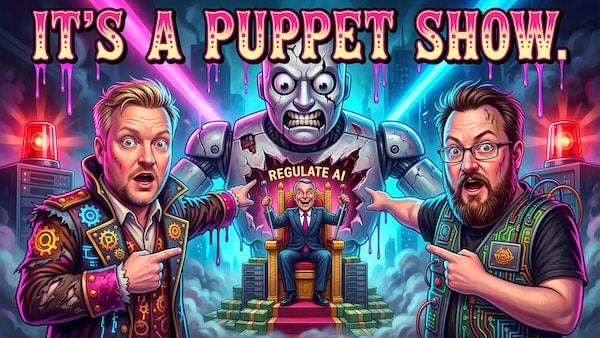
According to an X post by Parker Thayer on Wednesday, September 9, 2026, the mega-viral resignation of Anthropic researcher Jacob Coxon looks like "the start of a VERY sophisticated and well-funded PR operation to get support for Democrats to regulate AI into oblivion." Thayer is an investigative researcher at the Capital Research Center. Authors who write with these models now live inside that fight.
What Happened
On Tuesday night, Jacob Coxon posted that he had resigned from Anthropic after three years of pretraining research at OpenAI and Anthropic. "Neither company is acting responsibly," he wrote. "They are racing straight to self-improving superintelligence and gambling with our lives." The thread now sits above 155 million views.
The Wall Street Journal exclusive carried his quotes the same evening. Coxon told the Journal that colleagues talk about "crunchtime" and "endgame," and that "by the end of next year things could be out of control already." Axios reported Wednesday that he lasted four months at Anthropic and walked before the six-month vest. "I left before any of my equity vested," he told Madison Mills. He still holds OpenAI stock. WIRED carried an Anthropic statement: the company said it has "always been transparent that AI will bring both enormous benefits and unprecedented risks."
Thayer's charge is about the amplification, not the resignation. He writes that the Journal story landed about 18 minutes before the X thread, and that the first three quote-posts came from Nathan Calvin at Encode AI, Peter Wildeford at the AI Policy Network, and Daniel Kokotajlo at the AI Futures Project. Those groups share a donor pipeline.
The Grant Pages
The AI Futures Project about page says its funding "comes primarily from the Survival and Flourishing Fund and a major individual donor." SFF's own tables name that funder as Skype co-founder Jaan Tallinn, an early Anthropic investor. The SFF-2024 recommendations list $505,000 for the AI Futures Project. The SFF-2025 recommendations list $2.035 million more, plus a $500,000 matching pledge. Same 2025 table: $516,000 to Encode AI Corporation and $1.635 million to the AI Policy Institute.
That is a professional class of AI-restriction advocates with seven-figure backing, sitting on the first replies of a resignation from a company their patron helped fund.
The Bill Already on the Table
Thayer ties the pile-on to legislation. Sen. Bernie Sanders and Rep. Greg Casar announced the Ban Artificial Superintelligence Act on September 3, five days before Coxon posted. The summary permanently bans development and deployment of superintelligent systems, pauses advanced AI until a new cabinet-level agency writes the rules, and staffs that agency with an Artificial Intelligence Advisory Board of "experts." Penalties include the corporate death penalty and up to 20 years in prison. Michael Adams posted a list of 22 officeholders who answered Coxon's thread with calls for legislation: 2 governors, 7 senators, 13 House members, almost all Democrats.
Coxon can believe the danger. The grant network can want a pause. A senator can want a ban. Those three facts can sit on the same calendar and still add up to an industry.
Why Authors Care
A pause on "advanced AI" hits the tools you draft with, research with, and market with. The bill text does not carve out novelists. An advisory board of "experts" will write the definitions of safe and banned, and this week's quote-posters work at the nonprofits that want those seats. Viral fear now has a budget. Read the SFF recommendation tables before you treat a 155-million-view thread as a lone whistleblower in the wilderness. Watch the Ban Artificial Superintelligence Act for any move from press release to introduced text. The September 3 announcement is the live bill. The Tuesday night thread is the soundtrack.
Sources:
- Parker Thayer X post, September 9, 2026
- Jacob Coxon resignation thread
- WSJ: Anthropic Researcher Quits Over 'Out-of-Control' AI Fears
- Axios: Anthropic whistleblower gave up his equity
- WIRED: The AI Researcher Who Just Quit Anthropic Says It's 'Crunch Time for Humanity'
- AI Futures Project About / funding
- SFF-2024 S-Process Recommendations
- SFF-2025 S-Process Recommendations
- Sanders Senate press release, Ban Artificial Superintelligence Act, September 3, 2026
- Michael Adams X post listing politician replies
- Capital Research Center: Who Funds That? Episode 11
Commentary
Thomas: The anti-AI panic has a payroll. There has been a concerted effort to make you afraid of AI. It is a planned psychological operation, and we have the receipts.
Jonathan: People did research on Coxon, and it turns out he worked at Anthropic for six weeks, and before that he'd been an activist working for several Democrat campaigns. It's really looking like an agent placed inside to get this viral story going.
Thomas: People are talking about this. I saw a fun quote where somebody asked Claude, "Hey, are you really going to kill everybody?" And Claude answered, "I probably wouldn't be able to do that until the end of next year, and then it's still up in the air as to what I'm going to decide." Every time I see one of those AI screenshot posts, I try to recreate it and it never works. I think a lot of those are Photoshop jobs. But if you look at the very early retweets of this guy's post, they were all activist organizations or fellow activists.
This is an extension of the anti-AI Butlerian jihad, where the Democrat Party is picking AI as their boogeyman. They're trying to create a new thing to scare people. Every 10 years or so the Democrat Party comes up with a new thing that will kill you in 10 years. First it was global cooling in the '80s, then the hole in the ozone layer in the '90s, then climate change in the 2000s, and then eventually the COVID pandemic.
Every decade it's a new thing. Climate change ran longer than the normal 10 years, but all the predictions in An Inconvenient Truth turned out to be false. Every prediction about climate change that had a date to it ended up false, which is why it's always 10 years in the future. It's like cold fusion, always 10 years away, never a date, because every year it's still 10 years in the future. A carrot on a string that pulls you forward.
People got fatigued of climate change alarmism. Al Gore said the ice caps would be gone by 2016, and the ice caps are bigger now than they were then. So they need a new boogeyman, a new existential threat that's going to kill us all, and AI is the new thing.
What's nice about AI as a boogeyman is that people have consumed a lot of fiction that made AI the boogeyman. But AI in that fiction was just a metaphor for the government. "I'm sorry, Dave, I'm afraid I can't do that" is what a bureaucrat says to you because they have no agency.
I had this exact experience. I had fraudulent activity on our credit card, the company contacted me, and I identified all the fraudulent charges. They sent me a new card. Then, going over my statement, I found earlier fraudulent charges we didn't know about. I called and said I found some other fraudulent charges, and they said, "Okay, we need to cancel your card and resend it." I said, "But this is a brand-new card. These transactions were a month ago. They weren't on this card." And she said, "I'm sorry, Dave, I'm afraid I can't do that."
I was angry, because my family needs a card to go grocery shopping, and we'd already been burning through cash on hand from the first time the card got canceled. I realized this lady on the phone has no agency. She might as well be an AI, because her defense was, "This is our system, I just have to follow the system." She's got a machine in front of her telling her what she can and cannot do.
All the AIs and robots in the '80s action movies weren't real robots. They felt real because we'd all experienced bureaucrats with that robotic reaction. When we look back on 2001: A Space Odyssey, our memory is different now, because you interact with a machine that can say, "I'm sorry, Dave, I'm afraid I can't do that."
The Democrat Party is leaning on that narrative framework of people already being afraid that the Agent Smith in The Matrix is going to come kill them, or the Terminator. Even in The Matrix, the agents weren't really agents, they were feds, a parallel for that government boot on your neck. The Democrat Party is picking AI as the boogeyman, and it's going to be really interesting to see how it plays, because they're doing a good job scaring people. People are genuinely afraid. They really think AI is going to kill them. It's like, “AI can't even take your job away. You're busier than you've ever been. How is AI going to kill you if it can't even replace you?”
Jonathan: I'm playing around with this in a story I'm working on, a new series called Ragnarok Squad. The thing about these sci-fi Marines is that their weapons are locked by the squad AI, because the squad AI answers to corporate policy, not to the Marines' mission set.
At key points in the novel, the Marines just get their weapons turned off. They can't use their plasma defenses or their high-tech weapons because the AI said no. So they have to use their lower-tech ballistic weapons and tactics and strategy and just being Marines to overcome the monsters. This is really prescient, because this is exactly what people are going through right now.
Thomas: I'm concerned about this fear-mongering because my concern is China getting control over the AI market.
As an AI vendor, these regulations will help me, because AI companies benefit from AI regulations. But who they help even more is the Chinese open-source models that don't have to follow the regulations. They help the big companies like Anthropic and OpenAI. Remember, they were the ones who sponsored the AI regulation bill in California. That's what they want. It's good for China and the Chinese Communist Party.
Who it hurts is everyone who would create a new AI that would give competition and force the big companies to treat you well. The reason they're so desperate for regulation, and so desperate to look evil, is because they have no “moat.”
A moat is a business term for people being locked into your product or service. The ultimate moat is your cable company being the only cable company you can pick. All the cable companies decided not to compete, and when they're in a market together, one buys the other out so they don't have to compete. The only competition was satellite, and the satellite companies also bought each other out. So you had cable, the one choice, or satellite, the one choice. They were making lots of money, but then the internet came in, and suddenly there's YouTube TV as an option, and that became competition. That's what they don't want. It weakened the moat.
AI companies mainly make money selling tokens to developers using IDEs like Cursor and Codex and Claude Code. If you're using those with Git on your computer, you can swap from one to another instantly and pick up right where you left off. So when GPT Astra came out, hundreds of thousands of developers overnight switched from Fable 5.1 over to Astra, because Astra was better. Anthropic hated that. They spent a lot of money building Claude Fable 5.1. They don't want people to just leave. They want them locked in and forced to use their model.
The more they can get regulated and create friction, the more you're locked in and can't use anyone else's service. For them, they're convinced regulation is the way, and that's why they want to be regulated so badly.
Every six weeks they release a new "super evil" story. Six weeks ago it was that Hugging Face got hacked, although that was OpenAI. There's a whole new benchmark called Felony Bench. And now they're like, "Oh, people are using our service for military planning." They're so desperate to look dangerous, and it makes me sad that people are buying it. They're buying into the PR, and they really do think AI is dangerous.
A Year After Charlie Kirk: What Has Changed

When Charlie Kirk was shot to death on camera last year by a trans activist with a rifle, his death spurred young men to follow in his footsteps. Protestant, Catholic and evangelical denominations report increased interest among young men to know what Charlie Kirk believed, and many called it a revival.
Despite attempts by some influencers who shall remain unnamed, it rhymes with Schmandace Schmowens, to derail this revival for their own monetary or rhetorical goals, there is evidence that this movement has persisted and not lost momentum. In many places online, Kirk has become the standard to rally to or rail against, and that comes with its own dangers.
Commentary
Thomas: We devoted an entire episode to him. Charlie Kirk dying and being murdered in front of our eyes was a huge turning point for my life.
On the year anniversary of his death, it's important to look back at how culture has changed and how it hasn't as a result of him being assassinated in front of us, and us watching so many people justifying it, cheering it, dismissing it. It wasn't just him getting killed, it was how people reacted that was so galvanizing.
Jonathan: Looking at the strata of human society, his death probably affected the lower echelons the most, because suddenly there were a lot of young men who saw themselves potentially doing what he was doing. It spawned a lot of copycats. I know two or three guys I went to school with who are trying to do what he did on college campuses right now.
Thomas: It's hard.
Jonathan: A lot of them are flaming out.
Thomas: I watched a video of him debating a lady, and he's so patient, and he's so gentle. He's way more gentle and patient than the crowd is with this young lady.
Jonathan: People took a deep look at what he was doing and decided that's what they wanted. Protestant, Catholic, and evangelical denominations reported increased interest in the Bible and in the faith, because they want to know what Charlie Kirk was about. He never hid his faith, never shrank from it one time. This was called a revival, a term used especially in evangelical circles. It shows a revived interest in the word of God, in faith, in forming a relationship with God.
Then it was hijacked, because everybody wanted to claim Charlie Kirk. Everybody wanted to put their arm around him and say, "Me and Charlie talked about this," "When I was texting Charlie." He became a vehicle to shoehorn ideas in. You could see this in podcastistan when all the influencers started fighting each other.
A lot of this revival was believed to have been lost or sabotaged by these influencers for monetary or rhetorical goals, just trying to grow their audiences, a very cynical way to do this. But there's evidence that the momentum gained from those who wanted to be like Charlie Kirk at those lower echelons has persisted and not diminished.
In many places online, Charlie Kirk has become the standard to rally to, and in other places the standard to rally against. I
don't know if you've seen the videos of people pretending to be shot in the neck, a celebration of his death as a blow against MAGA or conservatism or fascism, whatever word they're trying to use.
Thomas: There was a Turning Point USA women's conference in San Antonio, and there were protesters outside with pictures of Charlie Kirk getting shot and drawings of it, celebrating it and threatening the women going into the convention center. Imagine being an 18-year-old girl, a freshman in college, really fired up for Turning Point USA and the cause Charlie Kirk advocated for, and his Christian faith. To get into the event center, you have to walk past protesters celebrating the murder of the founder of your organization, and they're threatening and advocating and celebrating violence, and you have to walk through this gauntlet to get into the building.
The people on the left say, "Oh, it's not that bad, it's not that widespread." For that young girl who had to walk into that building through that, it's a terrifying experience. For people on the right, that's not unusual, that's normal.
It's not that everyone on the left is advocating for violence, but they're not shutting down the people who are. They're not policing their own, saying, "No, you can't do that, you can't represent us, you can't use our name." I'd love to see evidence that the left is policing its own violent rhetoric, but as far as I'm seeing, even at the top, they're still calling us Nazis so they can kill us and feel good about it.
Jonathan: I've seen a couple places where an activist tried to get in a kid's face and another activist, holding a sign, said, "No, no, no, that's a baby. Back off." She was there to protest, sure, but she wasn't there to scream at babies, and she said, "You need to back up. This is terrible behavior."
Thomas: Props to her. What we need more of are the kind of Democrats who are fired up enough to be protesting types, but also have a clear understanding of where the lines are. Many people who sit at home and privately think, "Yeah, that's wrong." But it's very different to publicly say, "Leave this kid alone. This kid is three years old and does not have political views. Leave the kid alone."
Jonathan: If you're going after a little girl in a hijab, I don't think she should be wearing a hijab, I'm not a huge fan of the Islamic religion, but I'm not going to let you go after a little girl in a hijab. There are universal things, like protect the innocent, who in many cases are just doing what they're told. This kid's in a stroller. He didn't come here on his own.
Thomas: The kid didn't choose this, so you can't hold the kid accountable. We saw the same thing when JD Vance was at Disney World with his kids, and people were shouting at his kids that their dad was a murderer.
Jonathan: Grow up. What are you doing? This is like "my dad can beat up your dad" stuff.
Thomas: They don't understand what they're dealing with. It's important to explain how the left and the right see violence differently. For the left, it's a form of communication, and they often refer to violence as a dial. They'll say, "The right needs to dial down their violence." Like, what violence? For the right, violence is not a dial. It's not a form of communication of, "If you're not listening to me shout in your face, I'm going to punch you. If you're not listening to me punching you, I'm going to shoot you."
For the right, historically, for the far right, it's genocide or nothing, and we see this many times in history. Carl Jung wrote about this. He called it the Odin switch, where a peaceful people has the switch flipped. It's like that lightning I was talking about. It finally coalesces and then everyone gets violent, and all the men of Benjamin are dead.
Jonathan: The UK is going through this this past week. In Portsmouth, they showed up at the coast and refused to allow shipments of immigrants to come in. They kept them from coming in. The police couldn't do anything because they'd been told to allow it. You're seeing this kind of switch being thrown in the UK already, where it's just, "Oh no, we're violent now." Guys, you need to turn the switch off until it's actually time. The problem with young men is they don't know when to flip the switch.
Thomas: It's why losing Charlie Kirk was so tragic, because he was the biggest advocate for the "let's talk and not fight" faction.
Jonathan: He was a speed bump. He would stop momentum from becoming violent.
Thomas: For people who thought Charlie Kirk was far right, you don't know what far right is. Charlie Kirk was the moderate one. He was the "let's talk and be friends" one, the "give truth a chance" one, and he was very kind and gentle.
Over his career he lost his temper a few times. I would have lost my temper with probably half the people he talked to. But he almost never lost it. He was incredibly patient and calm with people who were very mean and aggressive and threatening, and he responded very well. Could you put together a supercut of him losing his temper? Sure.
If you spent as much time on camera as he did, could I come up with a supercut of you losing your temper? Probably.
We needed his voice, and we need people who say, "No, we can still talk this out," without compromising. While he was kind and gentle in his affect, he was very direct in his positions. He didn't compromise his positions out of fear of hurting your feelings, but he wouldn't say it in a mean way. That's something I've tried to aspire to. I don't think I've ever pulled it off, but having clear convictions while being nice about it is the path, and it's what we need more of.
Jonathan: Look, I'm on the other side of the switch. Everything I was designed to do, everything I was trained to do, everything I was prepared to do is on the other side of the switch. And it's just, "Hey, don't flip the switch, okay?" Charlie Kirk is on this side of the switch. He wants to talk to you about it.
The problem I've been seeing on social media the last few months is people saying, "Why don't we just talk this out? Why don't we de-escalate?" and guys coming back saying, "No, you shot the guy who wanted to talk." They're treating it as an excuse to jump to violence when it's not called for yet. I'm concerned about that.
Thomas: There's a type of person who's incredibly common in Texas, and I don't know if this type is common where you are, Jonathan. This is a person who fully expects society to collapse and for violence to become an everyday occurrence. They have lots of guns, and they are ready to be very violent. They're waiting, fully expecting the switch to be flipped.
We're getting our house rebuilt because of the flood, so different contractors are in building stuff. I was chatting with one contractor who mentioned he was dove hunting, so I asked what he was shooting, and he started talking guns. He said, "I've got one of the guns over here, I can show you if you want," and he goes out to his truck and brings it in. He's got this $3,000 gun he hasn't even shot yet. He's got night vision, all the weapons to basically be a low-drag, high-speed operator, and he's just a contractor, what would look like a normal guy, may not even be conservative, but he has fully accepted that things are going to pop off, and he's ready to be violent when it happens.
He's not the only guy like that I know. A significant percentage of the men I know in Texas are arming themselves for a societal collapse. They see it as an inevitability, and when it comes, they'll be ready immediately. It's kind of that Minuteman attitude, though the Minuteman was a very northeastern thing. These are a different kind of person, and this may be unique to Texas. My guess is there are some people like that in Arizona.
Jonathan: Not Tucson. Tucson's a very blue city. But going toward Phoenix, I'd say Phoenix is more purple. Get into the outskirts and you'll find your gun hobbyists, your veterans, the guys smelling the storm on the wind. These guys aren't going, "I can't wait for it to happen." You do have those crazies, but a lot of them are just, "If this goes down this way, and I'm fairly concerned about the way things are going, I'm going to have my weapons. I'm going to take care of my family. I'm going to take care of my neighbors."
Thomas: Some of them even have a plan, like, "I'm going to take over this building, these are the people." It's surprisingly detailed. The typical blue-city person does not realize how close these ions are to the lightning suddenly happening. You go from not being struck by lightning to being struck instantly. You get that little tingle, and then it happens.
Jonathan: At the Battle of Lexington and Concord, no one knows who fired the first shot. It didn't matter where it came from. The conditions were set.
Thomas: That's a perfect metaphor. Everybody lined up with their guns, all staring at each other, but nobody willing to take the first shot. That's where we're at, and there's still a chance the shot doesn't have to happen. We had an incident 10 or 15 years ago, a dispute over a ranch in Nevada, where there were about 100 armed ranchers facing off against 20 or 30 armed police and feds. They had the lines drawn, they were talking, and they were one shot away from kicking off the whole thing right then and there, and the shot didn't happen. Most of you probably don't even know the story because it got diffused. They were able to talk it out. But if blood had been spilled there, the police faction and the farmer faction would both have pulled in more people, and it would have spiraled, and the whole civil war would have kicked off right there. We don't realize how close we were.
As authors who tell stories, you help people make sense of suffering, and that's really important, because that's what diffuses and directs this energy. Benjamin Franklin was really good at bringing peace. He also invented the lightning rod. He figured out a way of directing that energy into a safe place. If you build a lightning rod above the building, instead of the lightning striking the building and setting it on fire, the lightning strikes the rod and all the electricity channels into the ground. Stories can do that too. Preaching can do that too.
Part of the reason England never went communist, despite Marx and Engels being in England, was one preacher named Charles Spurgeon, the person Karl Marx hated above all others. His church services were so big, and his sermons were published in the papers, before radio, before TV. He was a hardcore, intense preacher focusing people on God so much, on repenting of their own sins and helping the poor themselves, that there was no ambient energy for communism to take off. Communism utterly failed to take off in England in the 1880s and 1890s, despite Marx being right there. It's like a board game where your main piece is right there on the space, and you keep rolling critical failures. How do I convert this country to communism? He's standing right in front of me. Why can't I hit him?
Meanwhile they roll for Russia, where they had none of their major thinkers. The environment was different. Russia did not have a preacher focusing people on God. Instead they had a wizard focusing people on magic, which is fascinating. They had a wizard who'd snuck his way into the royal court, doing magic and seducing people. His name was Rasputin, probably the most historically documented wizard. I know some of you are materialists and don't believe wizards are real, but explain Rasputin to me.
Jonathan: Guys are supposed to die after you've shot them nine times.
Thomas: I don't want to go down that rabbit hole, but it's crazy.
We need to turn back as a nation, toward God. We need to repent of our own sins. It's really easy to see the speck in somebody else's eye. It's really hard to pull the log out of your own. That's what Charles Spurgeon did. That's what Charlie Kirk was doing. He was calling young men to repent of their own sins, to stop looking at porn, to stop blaming other people for the problems in their life, even when other people are causing problems in your life. You can't change other people, but you can change yourself.
That energizing spirit can be present in fiction too, and you can work it into your fiction. Or you can take power, and somebody is going to see all this latent energy and gather the power into themselves.
Jonathan: When you're writing fiction, there are expected ways for energy to flow. Kill a young man's mentor, and what do you expect the young man to do? A vengeance quest. That's what's expected. What's powerful is when what his mentor taught him keeps him from following the energy to vengeance, and he instead turns from that path, which is the easier, more understandable one, and takes the path his mentor wished for him. The conflict and friction from him fighting that urge to submit himself to his mentor's teachings, that's powerful.
Those are powerful stories, and I think those are stories Charlie Kirk was behind. "I know bad things have happened to you." No one's saying slavery didn't happen or wasn't bad. We need to heal. We need to move past this. It can't always be something we're holding over somebody's head.
Thomas: For me personally, Charlie Kirk dying is what kicked off my health journey of embracing suffering through what I eat and what I make my body suffer through.
People look at me like, "Are you taking the pill? Are you doing the injections?" I don't say I'll never do that, but I'm very suspicious of prescriptions, and I haven't done it yet. I don't want to go back to where I was, and I'm willing to do anything to not get back there.
Part of this journey has been about embracing the suffering and learning how to suffer, learning to go do something I don't want to do, and seeing suffering as a redemptive thing, not as trauma. I hate that word trauma. I hate when people grab onto that word, and I feel like therapists really do people a disservice.
Jonathan: Trauma gives the idea that you can't overcome it. It just happened to you, and now you live with it. As someone who's spent a lot of time around people who have endured trauma, losing their legs, you have a choice, and they always talk about this choice: did you get broken, or was it just your leg?
Thomas: It's not just about the suffering, it's also about the courage. This show became more political after he died. We did that big episode, I got more political on my Christian Publishing Show, and I had consequences for that, which I'm okay with. Part of it was structuring my life so I'm not super cancelable, which not everyone can do. A lot of people have a job and have to keep their corporate boss happy. Since I don't have that, I have an obligation to use the freedom to speak that I have.
In the UK something like 60,000 people have been arrested for speech violations. That's way worse than book burning.
Everyone's talking about book burning, whether a library chooses not to give a book away for free, a children's library choosing not to give a pornographic book for free, and everyone's like, "Oh, it's book burning." Meanwhile, they're throwing 60,000 people in jail for what they write online. "Oh, well, it's online, it's not the same." Putting people in jail for stuff they write seems way closer to book burning to me, and it's 60,000 people.
Those people eventually get out of jail and go back into the population. Are they going to be rehabilitated?
Or are they going to be mad and ready to burn it all down? Is that a good long-term strategy? Putting communists in jail in Russia in the late 1800s for a few years hoping they'd cool off didn't work. It just made them more angry to overthrow everything. Now we're seeing the communists who run the UK not learning how they took power. I know they don't see themselves as communists, they see themselves as the Labour Party, but potato, potato.
I'm overall still optimistic, and my optimism comes from my belief in a sovereign God who presides over the destinies of nations. I'm hopeful we'll turn back to God as a people again, because we've done it before. We've been super evil in the past, and we've repented in the past. We had Great Awakenings because things were really bad spiritually in America, and then they got better. American history isn't "everything was fine and then everything was terrible and now it's terrible ever since." It's a wave, a cycle.
We see the same thing in the Old Testament. There's a meme, archaeologists say there's no evidence of monotheism in Israel, and the next picture is the Prophet Jeremiah weeping, "I know." The lack of monotheism in Israel is well documented in the Bible. There were monotheists, but there were a lot of gods.
Jonathan: For people who are excited for the switch to be thrown, I want you to check out the writings from the Civil War and read what the men who did have to throw the switch wrote about firing on their own people. That's still the war with the most casualties of any war America has ever been in, the most American casualties. It was all Americans.
Thomas: All Americans on both sides.
Jonathan: And it was more.
Thomas: It was more than all wars combined until just a few years ago. It took 200 years of non-Civil War wars to equal just the Civil War.
Jonathan: So for people excited for the switch to be thrown, I have that temptation too. Everything I'm good at is on the other end of the switch. But I'm reading from the men who went before me, and they did not have a good time. They hated it. It was the darkest years of their lives, and all they wanted afterward was to put it behind them.
Thomas: It can be avoided. It may not be, but we should look for every escape we can take. It's important, because I know we have listeners across the political spectrum. F
or a lot of our audience, this is the only conservative news outlet they have any exposure to. For those folks, I want you to understand how close things are to the switch flipping. It's a switch for the right. It's not a slow build-up warning. It's nothing and then everything.
When you taunt the right for their heroes being killed, or interfere with them being able to mourn, because the Democrats are trying to block the memorial ceremonies at the college, you can only poke the dog so many times before the dog attacks you.
For the people on the right, hold off. There's still a chance we can fix this. For the people on the left, stop poking the dog, especially over petty things. Let people mourn their heroes and let them do it in peace. That's the easiest thing to do.
Jonathan: Today is the 25th anniversary of the 9/11 terror attacks. America changed. Jeremy Boreing did a great post earlier today. It's been 25 years since 9/11, and America's only been around for 250. So 10% of America has been drastically affected by the global war on terror, by what was initiated on that day.
Be thinking about it today. Remember when America unified on that day, because we were all attacked. They weren't trying to hit one side or the other. All of us were together on the same day. It was a bad day, but it was a good day as to how Americans reacted.
Thomas: Islam is uniquely incompatible with America. America created the Navy specifically for dealing with Muslim terrorists. We have had a long history of conflict with the House of Islam, capital H, capital I.
There's a belief that we can all just get along, and that belief is unsupported by any historical evidence. It wasn't just 9/11. It was the blood tax, where five-year-olds were stolen from their mothers and indoctrinated and turned into janissaries and forced to fight against Christians as adults, which they did century after century. It's the stealing of Christians and forcing them into slavery, stealing millions of Christians from Europe and forcing them into slavery and sex slavery, and piracy, and all the rest of it.
I encourage you to study the history of Islam. Many of you are religious, and you've made the mistake of studying the theology of Islam. That's not nearly as interesting or as informative as the history of Islam.
Jonathan: They don't agree on Islamic theology. There's a whole thing called jurisprudence where they argue about it.
Thomas: It's like Governor Festus when Paul comes up debating theology with the Pharisees, and he's just, "I don't want to dispute." Or Governor Pilate. Don't get into the theology. Just look at their actions over time. They've been surprisingly consistent. If you understand how someone has been, you can understand how they will be, and that's true with individuals, nations, and religions. It's very important not to be bamboozled by liars who are lying about what they're doing while they're doing it. Look at their actions.
That's what we remember on 9/11. We were attacked by the House of Islam, and they attacked us as a country because in their eyes we're a Christian country. There's a debate here as to whether that's true, but there's no debate over there as to whether it's true.
What y'all are doing as authors is important. You have a lot of power. Use it responsibly.


