


For Week Ending July 31, 2026
Literary agents just received official permission to charge authors they don’t think will make money for services —and the new AALA rules take effect September 1st. Substack's new AI detection tool is already flagging real human writers and could cost you subscribers overnight. We're also covering why publishing posts the lowest AI adoption of any creative industry, a Christian fantasy conference's 18-month defamation battle, a dictation app built exclusively for fiction writers with free beta closing August 3rd, and why collapsing trust in science is quietly fueling the biggest supernatural fiction boom in decades.
Publishing News
Literary Agents Get the Green Light to Make Money off of Unpublishable Authors

According to the official 2026 Revised AALA Canon of Ethics, now posted at aalitagents.org and effective September 1, 2026, the Association of American Literary Agents has rewritten key sections of its code to expand what members may charge for and how they may structure their businesses.
Section 10 of the new Canon explicitly allows a member or the member’s agency to offer marketing, promotion, web design, or other work to clients for a mutually agreed fee. Representation cannot be contingent on buying those services, and clients must be told in advance that they are free to hire anyone else. In its positive framing, AALA President Regina Brooks told Publishers Weekly that authors now do the bulk of their own marketing and keep asking agents for help, and that the rules simply create a transparent way for agents to charge for that help while keeping representation independent. On the critical side, Jane Friedman warns this formalizes a shift toward fee-based income. With 39 percent of AALA agents reporting under $50,000 a year from traditional commissions, the temptation to steer clients toward high-margin services will be strong. Writer Beware notes that power imbalances make “voluntary” purchases hard for many authors to refuse in practice.
Paid Services to Non-Clients
Section 11 permits agents to sell both editorial and non-editorial services, including explicit examples like social media consultation and promotional content, to writers who are not clients, provided the agent gives written notice that the work does not imply or guarantee representation. Agents still cannot respond to a query by directing the writer to buy services instead. Brooks and the AALA present this as continuity with the 2022 rules, simply expanded and clarified so agents can earn a living while authors get clear disclaimers. Friedman argues the written disclaimer will not erase the hope many unpublished writers feel when an agent offers paid help, and Writer Beware flags the risk that service work becomes a pipeline into representation, especially now that full reimbursement of prior fees is no longer required.
Editorial Fees and the Reimbursement Change
Agents still may not charge clients for editorial work done while preparing a manuscript for submission. If a non-client who paid for editing later becomes a client, the treatment of those earlier fees is now left to mutual agreement rather than automatic full refund. The AALA describes the change as giving both parties flexibility and recognizing that some writers may prefer to keep the arrangement as paid work. Writer Beware calls the walk-back a weakening of earlier protections, and Friedman notes it lowers the financial barrier for agents to convert service customers into clients without returning the money.
Section 12 states that the AALA does not encourage members to act as publishers of their clients’ work because of inherent conflicts. It is now permitted if the agent and client execute a specific “Consent Regarding Publication” agreement, or equivalent, that clearly separates the two roles. Publishers Weekly reports this removes a prior outright ban and reflects the growth of hybrid and agent-assisted publishing models that some clients request. Both Friedman and Writer Beware highlight the conflict of interest. An agent who also controls the publishing imprint has divided loyalties on advances, royalties, rights, and marketing spend. The required consent form is presented as a safeguard, but critics say paper consent rarely levels a real power imbalance.
The new Canon keeps strong language on fiduciary duty, transparency, and disclosure of referral fees. Brooks insists the updates simply match what authors are already asking for. Friedman, Nathan Bransford (who called her analysis a must-read), and Writer Beware all see the same text as official permission for agents under financial pressure to build parallel service businesses. The rules take effect September 1, 2026. Authors who want traditional representation will need to examine an agent’s actual income mix, not just their sales list, more carefully than before.
Sources:
2026 Revised AALA Canon of Ethics (official text, effective September 1, 2026)
Agent Business Models May Be Shifting: What I Fear Will Happen – Jane Friedman, July 29, 2026
The AALA Makes Significant Updates to Its Canon of Ethics – Writer Beware, July 31, 2026
Commentary
Thomas: We covered this superficially last week because I thought, “Surely this can’t be true.” The AALA finally published their actual revised ethical guidelines, and it is worse than my worst projection of how bad it could be.
Thomas: Jane Friedman’s breakdown of this change is available free on her blog. I don’t always agree with her, but her criticisms here were all valid, and some of them didn’t go far enough. This is one of the areas where I think she didn’t go far enough, because I suspect she doesn’t realize just how much more money there is in author services than there is in the rest of this whole industry, other than working for bestselling authors.
Historically, that’s how agents made their money. They work with bestselling authors, and when you go to an agent, the agent signing you means something, or it did until just now. An agent signing you meant the agent thought your book would be so successful that 15% of your future earnings was worth working for free up front. That made an agent relationship valuable.
Now an agent signing you only has to mean the agent thinks you have money and will buy services from them. It basically breaks the word “agent” and what an agent even means. Under the new guidelines, an agent can have an affiliate relationship with an energy company and recommend it, and it’s totally acceptable as long as the affiliate relationship is disclosed.
Jonathan: When the agent starts selling you their brand of energy drink, guaranteed to make you produce more words per hour.
Thomas: What needed to happen to save agenting as a profession was some correction after this flood of new agents entered the market. Traditional publishing is losing market share to indies, so fewer people are employed there than before, and a lot of the people who lost their jobs put out their shingle as agents. A lot of them aren’t doing well. Some are making all their money selling editing and marketing PR.
These guidelines aren’t enforced by Congress or the police. They’re industry standard practices that set the norms, not any sort of guild enforcement. There’s no union boss coming to your house with a baseball bat over what you said on the internet.
They were always guidelines very much in the pirate-code sense. But they did let agents who held themselves to a high standard clearly differentiate. They could say, “I’m one of the good ones. I follow this rigid ethical code, I’m not trying to sell you anything, and if I sign with you it means I believe in you and in your book.”
Jonathan: And now it’s, “I’ll believe in your book more if you buy my web design service.”
Thomas: So there’s a massive conflict of interest, because agents now have a huge incentive to sign wealthy authors. Wealthy authors can pay for services, websites, PR, and coaching. Selling services to authors is a billion-dollar business, just like traditional publishing is a billion-dollar business. People do not know what they have unleashed.
The author services business has a lot of really sketchy corners. It’s not all sketchy, because authors do need to buy services, but a lot of it is selling people’s dreams back to them. The pitch always goes like this. You flatter someone and convince them you’re certain they’re going to be a star, and no one can do that with more authority than an agent.
“Your book is great. It’s going to be a star. It should be a movie, but let’s get it published first. Let’s go with Simon & Schuster.” Simon & Schuster rejects it because it’s not a good book, but the author doesn’t know that. They think it’s a masterpiece and they’re the next big thing.
So you scratch every one of those delusions. “Simon & Schuster said no. We’ll pitch Harper Collins next, but we’ll have a better chance if we level up your website and boost your Instagram. I have a program that can help. It’s $5,000. A little pricey, but it’ll really help.” The author signs the $5,000 PR package. Now you’re Author Solutions. Harper Collins says no. “Okay, we’re pitching Random House, but they really care about Facebook, so it’s another five grand to boost your Facebook numbers.” You just keep milking that cow until the author runs out of money.
Agents used to be protected from that, because they weren’t allowed to do it and still call themselves an agent. Now that they can do it, their flattery is going to be even more flattering, their service even better, and they can charge even more. This is a disaster, and we’re only through the first bullet point.
Jonathan: It reminds me of that ancient story in the Bible where Pharaoh dreams of seven skinny cows eating seven fat cows. As a kid, I always thought that was the weirdest mental picture ever. This is how it is. These starving agents are going to destroy the industry for themselves, and there’s just not going to be any agenting anymore.
Thomas: Anybody can call themselves an agent, and anyone can say they’re following the AALA guidelines even if they’re not a member. It’s like how I can say my Patron Toolbox tools comply with the Authors Guild’s guidelines on AI. I have a very low opinion of the Authors Guild; I’m not a member, but I can still say it, and it’s true. The AALA’s guidelines are going to have the same effect.
The affiliate change is probably the least bad, especially because they make it transparent. I make money off affiliates. For a microphone on Amazon, it’s about 4%, a couple of bucks. But for publishing services, websites, and book covers, affiliate commissions can be 25, 40, sometimes 50%. Then it becomes a real conflict of interest.
People who aren’t in positions of power don’t understand conflict of interest. It doesn’t mean you’re doing anything wrong. It means you have interests at cross purposes, which makes it hard to prove you’re acting in someone’s best interest. A good agent who wants to do well by her clients now has to go out of her way to prove she’s acting in a fiduciary way while she’s being compensated all these other ways and potentially making more money from them.
It’s that doubt. You can’t just have free and fair elections; you have to have elections that look free and fair. The lack of trust is as much of a problem as the actual problem. This is why banks put a big fancy metal door on the vault. Do we need 12 inches of solid steel? No. Do we have it, and is it very visible? Yes. Is the vault open during business hours? Yes. It’s about the show, and this change undermines that show.
Jonathan: If you’re editing a client’s manuscript yourself for submission, you can’t charge for it. But if it’s a non-client, you can edit their manuscript.
Thomas: And they changed the reimbursement rules. You can do editing for someone, then become their agent, and you don’t have to reimburse them anymore. So you can effectively charge your clients for editing. You just have to make sure the cart stays before the horse. These are really lax.
The biggest one is that agents can now act as publishers.
Jonathan: That’s really bad. If they publish your work, the money goes through them first.
Thomas: The data goes through them first. It’s all of the downsides of being traditionally published and all of the downsides of being indie published, something you could do yourself in two hours of work.
Jonathan: It’s adding more downsides to being indie published.
Thomas: It’s indie publishing without the data, and traditional publishing without the reputational boost. Agents are not good at publishing. These small micro-publishers can’t afford big advances because they’re not good at publishing. They haven’t made money, they’re not successful, and they don’t know how to create a bestseller or determine whether a book will be one, because if they could, they’d have money. The size of the advance is the ultimate test of how successful a publisher has been. If they’ve had no success, they have no money for an advance. Somebody in the chat said it’s the new vanity publishing, and that’s exactly right, because as an AALA agent they can stroke your vanity and sycophantically convince you to give them all your money.
Jonathan: Which might be all you wanted in the first place.
Thomas: We already have Author Solutions for that. It’s a hydra with a million different imprints, Xlibris and the rest, and half the sketchy author-services publishing companies are Author Solutions behind the scenes. Now agents can do it too, and the agent becomes a point of friction, because it’s the agent’s KDP account, not yours. The agent uploads and manages the metadata. Want to change or republish your book? Now you have to go through your agent, who charges you, when you could do it yourself for free.
Jonathan: And they’re the ones with access to the dashboard, which they won’t give you because all their other clients are on it. You won’t see the data, which means they may not even tell you how much you made. They’ll just send you some money.
Thomas: So now you have to trust that their numbers are accurate. This is so bad.
Jonathan: The usual e-book split with a publisher is about 50%. Now add 15% for them agenting it. It’s a worse deal.
Thomas: And the agent gets half of the next Anthropic settlement if they’re your publisher. This is going to take advantage of so many low-information authors, because a lot of people don’t know much about publishing. They think indie publishing is difficult, and that’s exactly who Author Solutions preys on, because they don’t realize basically all the technical challenges have been solved.
You can buy a $200 piece of software that typesets your book. You can get a really solid cover from 100 Covers for a couple hundred bucks. You spend an hour clicking next on kdp.amazon.com, and you’re published. It’s less than $500 for high-quality typesetting and a solid cover. Is it the best cover? No. Can you get the best cover on your own? Also no, because you don’t yet know what makes the best cover. That expertise is what a successful publisher brings, and to know they’re successful, they have to have money, because that’s what success means.
Jonathan: And you know who’s not going to get sucked in by all of this? Author Update viewers.
Thomas: I realize I’m preaching to the choir, but I need you radicalized enough to help your friends. Every friend at church who says, “I want to write a book,” tell them, “Make sure you don’t sign with an agent.”
Jonathan: I have a YouTube channel for you to watch and a podcast for you to listen to. Don’t do it. Save them.
Thomas: I feel bad for legit agents, because the easiest money for the next couple of years is going to be calling yourself an agent and then bait-and-switching and rug-pulling people into buying services from you.
Jonathan: Predatory behavior. Set up a watering hole and pick off the sick ones that come to drink.
Thomas: I’m not an agent anymore, but I had high respect for it as a profession. Agents used to serve an important role protecting authors from predatory publishers, acting as a shield against bad contracts and bad practices. Now the agent is doing the bad practices.
It’s like a corrupt country where the police can’t be trusted. As a kid, I went on a mission trip to Russia, right after the fall of the Soviet Union, and we learned that if you get robbed, you don’t call the police, because the Soviet police, who are now Russian police, will also rob you. The purpose of the police in Russia isn’t to protect the people from bad people, it’s to protect the government from the people. We used to have agents who served and protected authors, and now there’s nothing keeping them from becoming just another crime syndicate.
I want to be wrong. I want the AALA to say, “No, we’re going to change these rules.” But there’s so much money in this change. It’s partly a symptom of traditional publishing falling. These agents aren’t making money in traditional publishing anymore, so this is how the people who lost their jobs try to make money off indie authors by putting their hands in indie authors’ pockets. If you’re an indie author, just say no. Hire experts, pick them yourself, and vet them yourself. We have a job board at authormedia.social.
Realm Makers Leaders Break Silence on 18-Month Defamation Fight

According to an official community email from Realm Makers, conference leaders Scott and Becky Minor have ended 18 months of near-total silence about a defamation lawsuit that has drained their resources and targeted the Christian speculative fiction community.
The Accusations and the Response
David Solomon, who has used multiple aliases over the years, began contacting Christian authors with claims as early as 2012 and publicly accused author Bryan Davis of child trafficking starting in 2015, according to Realm Makers’ detailed timeline. In October 2024, Solomon contacted Scott Minor with the same claims about Davis. Minor reviewed the materials and found no supporting evidence. Realm Makers then banned Solomon from its private community, RealmSphere, for misusing the platform. By March 2025, the accusations expanded to include Scott Minor and Realm Makers itself. The Voices for Voices podcast, hosted by Justin Alan Hayes, amplified the claims across dozens of episodes and videos. Realm Makers and the Minors filed a civil defamation lawsuit in late spring 2025. They state the claims are baseless and that no verifiable evidence has been produced.
Why the Silence Broke Now
In their official statement to the community, the Minors say the attacks have damaged their reputations and their ability to serve Christian writers. They describe the campaign as targeting a widening list of authors in the Christian fantasy space for more than a decade. They avoided public online engagement while pursuing legal channels, calling internet battles unproductive, and decided to speak only after the financial and emotional cost became unsustainable. A GiveSendGo campaign now seeks $50,000 for legal fees. Early figures showed roughly $11,866 raised. Any surplus is designated for Realm Makers services and scholarships.
The Conference Continues
Realm Makers held its 14th annual conference and Expo June 24–27, 2026, at St. Louis Union Station. Publishers Weekly reported nearly 350 in-person writers plus 72 online attendees and 103 vendor booths, with no mention of the legal dispute. Christianity Today previously documented the organization’s growth from roughly 60–85 early attendees to 475 in 2024. The event remains one of the primary professional gatherings for Christian authors writing fantasy, science fiction, and related genres.
Why This Matters for Authors
A long-running series of serious allegations against a niche conference and its associated authors has now entered open legal conflict. The absence of criminal charges or independent corroboration has not stopped the claims from circulating. Authors connected to RealmSphere or the conference face reputational risk by association even when unnamed. Community support for the legal fund and the decision to document the timeline publicly signal an attempt to draw a firm line. The case highlights the vulnerability of small, faith-based creative communities to persistent online campaigns that traditional publishers and larger organizations rarely face at the same intensity.
The Minors frame their legal action as defense of both their own names and the broader author community they have served since 2013. The outcome will shape how Christian speculative fiction organizers and writers respond to similar attacks in the years ahead.
Sources:
Realm Makers Christian Fantasy Conference Leaders Open Up About Defamation Against Them And Their Organization (Fandom Pulse, July 29, 2026)
Defamation Against Realm Makers & the Minors (GiveSendGo)
Official Realm Makers community email statement (shared July 2026)
Christian Speculative Authors Gather for Craft, Community, Cosplay (Publishers Weekly, June 30, 2026)
Evangelical Fantasy Is on a Quest (Christianity Today, January 13, 2025)
Commentary
Jonathan: We went back and forth on whether to treat this as a story, but we thought there was educational context for our viewers here.
Thomas: I don’t put any stock in it. I did some research, and this person, whose name keeps changing, is so small potatoes I didn’t even know if we could name him, because I don’t know if he counts as a public figure. His videos complaining about Realm Makers had about 11 views. It’s just him rambling for two hours.
Jonathan: Why treat this like it’s a threat?
Thomas: When we get stories like this, I pull out my PR Crisis Handbook. When there’s negative news about you, you have seven responses, and we’re going to go through them.
- Ignore - Almost always the best approach.
Go on Vacation - Put your phone away and go camping.
Flood the Zone - Fill the channel with some kind of distraction.
- Deny - “That never happened!”
- Righteous indignation - “How dare you!”
- Apologize - “I’m sorry, let’s move forward.”
- Clarify - “What I really meant to say was…”
- Diminish - “This is getting blown way out of proportion!”
Minimize - This is only a tiny percentage of what we do.
Deflect - “The other guy is way more corrupt!”
- Embrace It - “Yes, it happened, and I’m glad it did.”
Double Down - Sell the meme shirts.
Ignore
Option one is to ignore it, which is almost always the best approach. There are two ways to ignore. One is to go on vacation. If it’s an acute firestorm, go camping for a weekend, leave your phone in the truck, and by the time you come back everyone will have moved on. The other is to flood the zone, filling the channel with a distraction so people talk about something else. This is almost always the best approach to almost everything, because most attacks are like a curse without a cause, a butterfly that never lands. Ignore it, and it floats away.
Deny
Option two is to deny it. The problem with denial is that you can’t prove a negative. How do you prove something never happened? You can only prove that what the other person said was false.
Jonathan: You flood the zone with denial. Say “nuh-uh” over and over again.
Thomas: The more you say “I’m not a crook,” the more you sound like a crook, even if you’re not, because all people hear is the word “crook,” like Nixon. So denying is the most tempting response, because you want to be vindicated and have moral superiority, but it’s very risky.
Righteous Indignation
Option three is righteous indignation. “How dare you.” This is rarely right, but when it works it’s magical, because it can flip an entire group onto the attacker. If the attacker has a mob and you use righteous indignation correctly, the mob will proverbially stone the ringleader instead of you. There’s a case of this in the New Testament where a group petitions the king, I think it was King Agrippa, and they were so angry they killed the spokesperson.
Clarify
Option four is clarifying, which I think is the riskiest. People are angry, and you say, “What I really meant to say was,” and start offering clarification. It’s almost never the solution, but occasionally it is the right thing, and that’s when the people who are angry are your own people.
So often the mob is made up of people who already didn’t like you, and the more you interact with them, the more excited they get, because they’re getting attention from the guy they don’t like. Acknowledging that they exist feeds them the exact thing they’re desperate for, which is attention. As the big bad guy, you’re a father figure for them, and giving them attention fills the hole their actual dad isn’t filling.
Diminish
Option six is to diminish, and there are two ways. One is to minimize: “This is only a tiny percentage of what we do.” That wouldn’t apply here, because the accusations are so bad. The other is to deflect: “The other guy is way more corrupt than I am.” In politics, whataboutism sometimes works. You keep pointing at how bad the other party’s guy is, so people don’t notice you spent $30 billion to build one mile of train and all of it went to your corrupt apparatus.
Embrace
Option seven is to embrace it. “Yes, it happened, and I’m glad we did it.” You double down, make memes about it, and join in the joke. That’s what JD Vance did when everyone made fun of him with memes. He dressed up as his own meme for Halloween. For certain kinds of attacks, this works.
Apologize
Thomas: Saying, “I’m sorry, let’s move forward,” is the strategy Bill Clinton used. He said “I’m sorry,” and his apology magically worked and everyone forgave him. It was a different time. I don’t think apologizing works nearly as well now. You never apologize to enemies, but sometimes you can apologize to friends. Apologizing is hardest when you didn’t actually do it, but it’s still sometimes the right approach to make the crisis go away.
Crises aren’t about truth. People get hung up on what’s true, but you can never really know the truth with as much smoke and noise as a crisis generates. You can only manage the perception of the crowd, and the goal is to make the crowd go away.
Jonathan: Who you apologize to matters, because if you apologize to your enemies, your supporters hate you. We would never respect any Marine Corps general who apologized to the enemy for what we did to them.
Thomas: Or apologized to the Army. That leader we would make disappear. Making fun of the Army is our thing, or vice versa. To be clear, I’m not a Marine.
Another reason you don’t apologize to the enemy is that it makes the enemy hate you and makes your allies disgusted.
So the Minors are having a very emotionally draining attack from a loud gadfly that no one was listening to. I’m in this world and had no idea what was going on until they made a big deal about it and emailed everyone. They did the worst possible version of not ignoring it. The whole purpose of a defamation lawsuit is to make something quietly go away. You bury an enemy under expensive litigation, and they disappear.
The lawsuit was a mistake in the first place, because a loser with no money is not threatened by a civil lawsuit that threatens to take away the no money he already doesn’t have. Then they ran out of money and went to the community for help, which forced the thing they were trying to make go away to be tried in the court of public opinion.
Jonathan: Which is the worst place to try something.
Thomas: So now everyone’s asking, “Who is this loser? What is he saying? Are his criticisms valid?” They’re spending so much attention vetting what he says. I feel really bad for the Minors. They haven’t gone through this kind of training. They’re not from the political world, and they don’t know what it’s like to have an enemy. As a public figure, you’re going to have enemies, and people are going to lie about you.
Jonathan: Some of us are thankful for enemies. It lets us do what we love.
Thomas: There’s a great poem, “If” by Rudyard Kipling, that’s useful for any public figure. A couple of lines are particularly appropriate here: “If you can bear to be lied about, and not deal in lies, or being hated, don’t give way to hating.” A lot of it is the emotional strength to keep ignoring the gadflies even when they’re saying terrible things. Are they lying? Sure. Does that matter? No, because mobs don’t care about the truth. This is why we don’t let mobs run the government. They’ll do terrible things and feel bad later, but that guy was still tarred and feathered, and there’s no getting it back.
Jonathan: You did the research and watched some of his psychotic 11-view videos.
If you were view number 12, it means no one else did the research into him, which means he’s now just as credible as everyone else. Compare this with things in the same space. The charge was child trafficking. Anything involving children and exploitation, tied to an institution with the word “Christian” on it, is death when people don’t do any research. His voice has been amplified to be equal because no one’s doing that research.
You release poison into the body, in this case Realm Makers, and you have to rely on the immune system to handle it. Sometimes that works. But you keep it localized and burn it out, or just ignore it in the first place. Zap it off like a zit.
Thomas: I will say one thing they did well was, I don’t think in their official statements they named the guy.
Jonathan: They did. I read the whole thing. They gave links to all of his videos.
Thomas: I like Scott and Becky. I’m doing this segment partly for their benefit. I feel bad for them, because it’s like watching a football team you want to win that has a great running game and just insists on throwing the ball and keeps throwing interceptions. Their run defense is bad, their run offense is good, and you’re just yelling, “Run the ball. Do good plays.”
Jonathan: I’m coming from a culture where the more you’re shot at, the better you are at your job.
Thomas: This is why I was really torn on doing this segment, and we talked about it for a while, because we’re now shining more light on it. But other outlets like Fandom Pulse are covering it, so now it’s news. It wasn’t news until people talked about it.
Jonathan: It didn’t have to be news.
Thomas: And if this gadfly has any sophistication, he can start trading up the chain. The little outlets cover it, then the bigger outlets, then Publishers Weekly, and suddenly it’s a big deal.
Jonathan: And he’s the source. He’s the Candace Owens of this whole thing. It doesn’t matter how crazy he is; it just matters that he’s the anti.
Thomas: So what do you do now if you’re Realm Makers? I think you have to flood the zone, and hopefully they have an attorney giving them good advice. The thing about defamation lawsuits is there’s no money in getting a judgment against somebody who has none. It’s just setting money on fire. Your feelings get hurt, you want blood, you want to take the guy down because what he did was really bad. He insulted your honor and your integrity.
Jonathan: And you convince yourself you’re helping other people by doing it yourself.
Thomas: You want your day in court, and your day in court costs $150,000, five years, and thousands of hours of work, stress, and trauma.
And there’ll be another guy. This isn’t the only gadfly in the world. The more famous and successful you are, the more gadflies hover around, the more envious haters and organizations that wish they were as successful as you, attacking you on any little thing. A good example is the royal family. Right after the anti-immigration protests, they were doing a parade, and the young princes and princesses were there. The whole crowd was booing them, and they just waved and smiled. That’s what you have to be willing to do if you want to be king. You don’t validate it, you don’t justify. You wave and smile, because you’re the king and they’re not. Scott, you’re the king. Just wave and smile.
Author Alerts
Russian Strikes Wipe Out 1.5 Million Ukrainian Books

If you imagine selling your book is hard, imagine trying to sell books in a war zone.
Russian attacks destroyed more than 1.5 million Ukrainian books and textbooks in July alone, according to the Kyiv Independent, citing data from the Ukrainian Book Institute. A July 2 strike on a BookChef warehouse in Kyiv erased roughly 800,000 copies, while a July 19 attack destroyed nearly 250,000 books at Knyholav and heavily damaged the Konvi printing house, one of Ukraine’s three largest presses, taking out hundreds of thousands more finished textbooks and printing materials.
Physical inventory and printing capacity remain soft targets in wartime, a sharp reminder that print supply chains can vanish overnight and that digital distribution and diversified storage matter more than ever for authors whose work depends on lasting access.
Sources:
Ukrainian publishers stand strong despite enormous financial losses from Russian attacks (Kyiv Independent)
Strikes destroy 1.5M Ukrainian books in July only (New Voice of Ukraine)
Commentary
Jonathan: These are soft targets, but you can lose everything if your warehouse gets hit.
Thomas: Does this have an impact on the war? No. Was this a waste of a bomb for the Russians? Yes. Was this the worst possible thing to happen to BookChef and this Ukrainian publishing apparatus? Also yes. You’re a Ukrainian bookseller trying your best to provide schoolbooks for Ukrainian schoolchildren and novels for Ukrainians. Talk about a noble purpose. Maybe there are guys in the trenches reading a Larry Correia book, because he’s popular in Eastern Europe, and now all those books are up in flames.
Jonathan: Another point for e-readers.
Thomas: There’s a Gandhi quote, I think it was Gandhi: “I was sad I had no shoes until I saw a man who had no feet.” My family has been going through a lot of crises right now. We had a difficult birth, and our house flooded, so we can’t live in our home. I did the math, and our number of children only increased by 20%, from four to five, but the number of children per square foot quadrupled.
We’re stacking our children three deep in a room, so we could focus on how little space we have. But we still have space, and a place to live. We’re living on a ranch with my parents, and the family who lived here before us raised six children with less square footage and no air conditioning, sharing an outhouse. A little perspective helps us have a better attitude about the challenges we face. So for the next three or four authors who email me whiny messages about how hard it is to sell their books, I’m going to throw this story in your face. “Did the Russians bomb you this week? No? Stop complaining.”
Jonathan: Although blaming Russians has been a time-honored pastime.
Thomas: I’m happy to blame the Russians. The way they’re conducting this war, the fact that they’re fighting it at all, is unacceptable.
This is another entry in our ongoing “Is it a book burning?” segment. While these books did burn, and it was actioned by a government, it doesn’t count as a book burning in my category, because if it was the Ukrainian government burning the books, it’s a book burning, but if it’s the Russians burning them, it’s not, even though the books are literally burning. Hopefully they’ll be able to print more and keep selling them.
Anthropic Pours Another $20 Million Into AI Regulation Push

According to Anthropic’s official announcement, the company donated another $20 million to Public First Action, a nonprofit pushing for stricter AI safeguards, bringing its total support to $40 million ahead of the 2026 midterms. The group educates the public and works with lawmakers across parties on transparency and risk mitigation for advanced AI models. Authors who rely on Claude and similar tools should watch closely, as heavier regulation could reshape access, training data rules, and creative AI features in the months ahead. Polymarket puts them at a 69% chance of going public in the next year.
Sources:
Anthropic: Donating another $20 million to Public First Action
Axios: Anthropic doubles funding for AI policy fight ahead of elections
Reuters: Anthropic to donate $20 million to US political group that supports AI regulation
Commentary
Jonathan: Everyone loves seeing Anthropic in the news again. Authors who rely on Claude should watch closely. Why? Who does regulation hurt?
Thomas: Competition. Ladies, find you a man who loves you as much as Anthropic loves AI regulation. They try a new angle every week, because they want the government to give them a monopoly. They don’t want to compete with China, with Grok, with Thinking Machines, or with some new AI startup that comes out of nowhere with a better model.
The fact that some Chinese models are just as good as Anthropic’s but cost 5 or 10% as much is terrifying to them. So instead of making their models cheaper, they’ve decided to be the most expensive, period, and they desperately want the government to hand them a monopoly to protect that.
Regulation always and forever benefits the biggest corporations. There’s a great myth, perpetuated by corporate media, that regulation hurts big companies, and it’s just not the case. It always helps them. Sometimes it picks winners between two big corporations, but it never helps the little guy, and it never helps the consumer. Competition helps the consumer. True, bare-knuckled competition is what helps the consumer. If you want the consumer to benefit, encourage more competition and make it harder for companies to get so big and powerful that they don’t face any. Big companies love regulation because it makes it harder for them to face true competition.
I was just meeting with a bunch of political people about data center policy. AIs need a lot of space, not square feet but square acres and even square miles of cooling and computation.
There’s a myth about data centers and water I want to debunk. The claim is that AI wastes water. Do you know where that came from? The author of the book Empire of AI got cubic meters and liters confused. Her spreadsheets were wrong, and the whole thing is based on really bad math. She’s published a retraction, but the lie has circulated the world three times.
You can build a data center with closed-loop cooling that uses less water than a single McDonald’s location. It’s such a myth, but people believe it because they want to.
There’s also some shenanigans from China trying to win the AI race. They’re putting landmines in front of America. They will put a landmine mothing-burger in front of the march to build American data centers just to slow America’s progress.
Kit Adds AI Landing Page Builder via MCP
According to Kit, creators on paid plans can now build and edit landing pages in seconds using the Kit MCP with Claude, ChatGPT, or any compatible AI tool. Describe the page you need and get a fully styled, publish-ready version tailored to your audience, or point the MCP at an existing page and describe the changes for an instant update inside Kit. Authors running book launches, lead magnets, or newsletter funnels on Kit can skip the editor clicks and generate conversion pages by talking to their AI assistant.
Sources:
Kit: Build and edit landing pages with the Kit MCP
Commentary
Thomas: This is a quick one, but it’s cool if you’re using Kit. They’ve added an MCP, so if you’re using ChatGPT or Claude, you can build a landing page just by telling Claude, “Build me a landing page for my upcoming novel or reader magnet in Kit.” Claude does the entire thing by itself once you connect the MCP, which you may have already done, since people have been using the Kit MCP server for emails. Building landing pages just got even easier.
Technology
Publishing Posts the Lowest AI Uptake of Any Creative Industry at Just 6%
According to the Creative Access 2026 Thrive Report, Progress under pressure, employer use of generative AI across the UK creative industries has jumped to 75%, up from just over half in 2025. Publishing sits at the bottom of the pack.
Publishing reported the lowest AI use of any surveyed sector at 6% for creative workflows. The report links that figure directly to ongoing concerns around copyright and authorship. By comparison, film, TV, radio and audio production reached 42% for creative processes, and PR, marketing and advertising hit 40%. Across all creative organizations, the dominant use case is general administration at 81%, almost double the 41% recorded in 2025. Research sits at 51%, and creative work such as design and ideation remains lower at 35%.
Training Gap is Real
More than 7 in 10 respondents received no AI training at all. Only 53% of individuals feel somewhat or very confident using AI, a figure that drops to 40% among D/deaf, disabled and neurodivergent respondents. 83% of employers expressed concerns about the ethical and inclusion implications of AI, essentially unchanged from the previous year.
Over 4 in 5 respondents reported experiencing financial pressure in the past year, and two-thirds said they had considered leaving the creative industries altogether. DE&I investment is plateauing. Three-quarters of employers maintained existing spend, and only 15% increased it, down from 44% in 2025. Individuals who received Creative Access services reported stronger outcomes: 85% said the support had a significant impact on their career, 65% reported career progression, and 71% felt optimistic about their future prospects.
Why it Matter for Authors
Publishing’s deliberate caution on generative AI protects the copyright framework that underpins every author’s livelihood. At the same time, the sector still faces the same talent retention and training shortfalls visible across the wider creative economy. Editors, publicists, agents and production staff from under-represented backgrounds are already under financial strain. When those pipelines thin, the books that reach readers grow narrower too.
The report’s core message is clear: AI is moving from experiment to infrastructure in most creative workplaces, yet the support systems that determine who can keep up remain uneven.
Sources:
Creative Access 2026 Thrive Report: Progress under pressure (PDF)
Commentary
Thomas: Everyone in publishing is freaking out about AI. Part of why we cover Hollywood and the music industry is that they’re facing way more AI than we are. We’re only at 6% adoption.
Jonathan: Across all creative organizations, the dominant use case is general administration at 81%. All the HR jobs just went away.
Thomas: AI is so good at reviewing TPS reports and emailing someone to tell them they didn’t fill theirs out correctly.
Thomas: This report is flawed in an interesting way. It looks at the creative industry through employers, so it’s only capturing traditional publishing. There’s no real indie scene in TV, especially in the UK where it’s almost all controlled by the government. There’s no big indie scene in Hollywood either. Most indie movies lose money. A few breakout films make the news and give us the impression that indie filmmaking is really profitable, but it’s the same Pareto distribution where indie filmmakers are all losing tons of money. The same is true to a lesser degree in radio and audio, though least of all in audio, because indie musicians can do pretty well. Austin is full of them. They’re all broke, but some are doing better than others.
Authors are different. Go to the bestseller list on Amazon for any given genre and scroll down, and chances are eight out of 10 of the top authors are indie authors. The money is flowing to indie authors, but this study only looks at the traditionally published side. And who’s adopting AI at a higher rate than 6%? Indie authors.
Jonathan: 100% of my LLC uses AI.
Thomas: You don’t use AI to write your book, but you use it for everything else, optimizing business processes and doing research. That’s the case for many indie authors. When I say the report is flawed, I mean methodologically. I suspect the numbers are accurate if your definition of publishing is the traditional publishing world and your worldview is that indies are small and don’t matter.
If you’re looking at BookScan numbers, it’s easy to get that impression, because BookScan doesn’t track indie sales in any measurable way. The BookScan lists are used to chart the popular bestseller lists, the USA Today list, the Wall Street Journal list, and sort of the New York Times list, though they really just pull names out of a hat of who they like. As the New York Times argued under oath before the Supreme Court, which we’ve done episodes on, their list isn’t really a bestseller list. Setting that aside, BookScan doesn’t count indie sales, because indie sales are predominantly e-book and, for a lot of indies, Kindle Unlimited. None of that money, which is billions of dollars, is captured by BookScan.
Jonathan: Which is why you need K-lytics.
Thomas: Somebody emailed me asking what that service is that has all the data, and I thought, “I’m not talking about K-lytics enough if people have to email me.” We do segments on them all the time, with genre breakdowns of what’s selling and what’s not. You can’t just look at BookScan numbers; you have to look at e-book sales, and K-lytics has the best data on those. This story is a useful snapshot into a part of the market, but it’s not as complete a snapshot as they’d like you to think.
One warning before you sign up for K-lytics. If you’re the kind of author who just wants to write the book you want to write and doesn’t care what readers want, K-lytics is confounding, because it’s answering a question you’re not asking. But if you want to know what readers want to read and how to write the kind of book that does well with them, it’s really helpful.
A lot of authors have exotic taste. They’re like a foodie who wants a hint of truffle, or really spicy food, and most readers are like a two-year-old who wants chicken fingers, ordering them at the Mexican restaurant. One of my children told me ranch salad dressing was too spicy.
Jonathan: My kids want boxed mac and cheese. I’m almost chef level, and I can make a really good homemade mac and cheese, but my child asked, “Dad, can we have the not-weird mac and cheese?”
Thomas: I’m a seventh-generation Texan, and my wife is an eighth-generation Texan. I eat raw jalapeños as a decongestant. If I get congested, I’ll have my wife buy raw jalapeños, eat one, and no longer have sinuses. I have a very high tolerance for spicy food, and my children think ranch dressing is spicy, but my wife shakes chili powder onto their food, because my children will be Texans by the time they graduate high school.
So many new authors are driving on the edge of the road, trying to find some new genre that doesn’t exist. Ask them what kind of book they write, and they say, “Well, it’s a little bit of this and a little bit of that,” like a foodie describing an exotic food nobody’s into. Most people just want McDonald’s. It’s okay to do the exotic stuff, but you can’t measure your success by how many burgers you sell, because McDonald’s is the normal kind, and what readers want is the normal kind. Learning to write the normal kind, and to write it well, is what earns you the right to take shots. Every once in a while you swing for the fences, and that’s okay, but if you don’t know how to get on base, you’ll burn out before you ever break the world with your artistic genius.
Jonathan: If they say they like Long John Silver’s, stop trying to give them squid cooked in its own ink.
Substack Rolls Out AI Detection Tool and Authors Face False Positive Risk
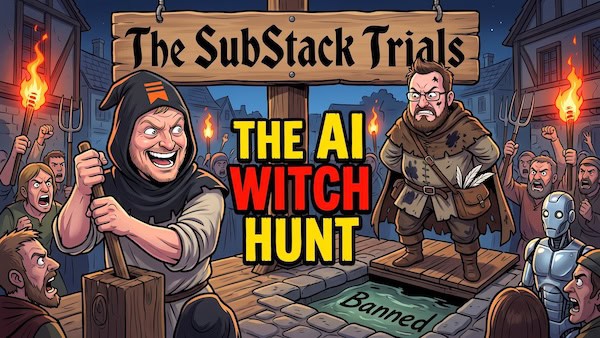
According to Substack CEO Chris Best in his July 21, 2026 post “Against Claudefishing,” the platform partnered with AI detection company Pangram and launched a new scanning feature the same day. Readers can now scan posts, notes, comments, and replies longer than 100 words that were published on or after July 21. The tool returns a percentage estimate of how much of the text is human-written, AI-assisted, or fully AI-generated. Results appear only to the person who runs the scan. The feature is live on web and iOS, with Android support coming later.
Pangram produces a probabilistic score rather than a binary yes or no. Creators can run the same scan on drafts before publishing. Writers can add a voluntary “How I make this” statement that appears when readers scan their work. Authors can report and remove scans they believe are incorrect, and can disable detection on individual posts. Substack states the tool does not ban or penalize AI use and does not affect discovery algorithms. Best coined “Claudefishing” for the mismatch that occurs when readers believe they are engaging with human thought but are actually reading machine-generated text.
Why This Matters for Authors
A false positive can damage reputation overnight. Readers who pay for a Substack subscription often do so because they value a specific human voice, and a high AI score, even if wrong, can trigger unsubscribes, public accusations, and lost trust. Non-native English writers, neurodiverse writers, and authors who use formal, structured, or list-heavy styles face higher historical false-positive rates on detection tools. Authors who lightly edit AI drafts or use AI for research and outlining risk scores that do not reflect the actual human labor involved, because Pangram only evaluates the final text, not the process. Book authors who cross-post essays, research notes, or serial fiction on Substack now operate under a public scoring system that traditional publishers and other platforms do not yet apply in the same way. The “How I make this” statement and the ability to disable or challenge scans give authors defensive tools, but only if they use them proactively.
Substack frames the feature as transparency, not prohibition. Best wrote that the company is “not against people using AI to assist their work” and that people should simply “know what they’re getting.” Pangram claims high accuracy, including 97.5% on fully generated AI text in independent tests cited by Substack, and its CEO has estimated a false-positive rate near 1 in 10,000. Real-world tests and writer pushback, including coverage in 404 Media and CNET, show the system is imperfect and that some human writing still triggers AI flags.
Authors who publish on Substack should treat the new tool as a live risk factor. Scan drafts before publishing. Write a clear process statement. Keep records of your drafting process if you later need to challenge a score. The platform has given readers a new lever of scrutiny, and human writers who get mislabeled will need the available appeal mechanisms to protect their livelihoods.
Sources:
Chris Best, “Against Claudefishing,” Substack, July 21, 2026
Substack Help Center: How can I detect AI on Substack?
CNET: I Test-Drove Substack’s New AI Detection Tool
404 Media: Substackers Say New AI Detection Tool Is a ‘Witch Hunt’
TechCrunch: Substack’s new tool tells you who’s been writing their newsletters with AI
Commentary
Thomas: Substack has rolled out AI detection, and they’re facing blowback and, I suspect, potential litigation. The real money is in suing Substack, because this is legit defamation. Going back to our earlier story, defamation is totally ineffective against a gadfly with no money, but it’s super effective against a corporation with lots of money.
Jonathan: What’s terrible about this is automated defamation, in an industry where you can measure the impact on sales.
Thomas: I love the term “Claudefishing.” There’s a phenomenon of people on dating apps realizing the person on the other side of the chat is just using Claude or ChatGPT for all their responses. Now you have dating where both the guy and the girl are using AI to have a completely fictional conversation. We’re getting to the model collapse of online dating. Part of me sees it like King Henry VIII sending diplomats to negotiate a marriage with the King of the Netherlands, where the diplomats are just talking to each other.
This is a lawsuit waiting to happen. For a defamation case to have teeth, and I’m not a lawyer so take the caveats, one of the important elements to prove is financial harm. You lied about me, it caused reputational harm, and that caused financial harm. Substack is uniquely vulnerable to this, because someone falsely accused of writing with AI, just because they write in an old style the AI trained on, is losing money. I have listeners who fed books they wrote in the ’80s or ’90s through Pangram, and it scored really high for AI.
Pangram is really good at detecting AI, and it’s also really good at flagging people who aren’t AI. It’s like finding a witch. We throw you in the water, and if you drown, you’re a witch. Congratulations, you also drowned everyone you threw in. Because authors get paid through Substack, and Substack is now falsely accusing some of them of writing with AI, those authors lose money when subscribers cancel.
Jonathan: And that’s over time, because this is a subscription. People pay monthly or annually, and you can’t estimate how long a subscriber would have stayed if they hadn’t been misled into believing you were writing with AI. So you’re looking at potentially infinite losses.
Thomas: And the more subscribers you have, the more you get, because a crowd draws a crowd. Popularity feeds on itself, and so does losing it. If I were an attorney, I’d be looking for authors right now to take a case against Substack, because the settlements, or the class action, would be totally worth my time. Be very hesitant to accuse anyone of using AI. We’re in a golden age where it seems like there are no consequences.
The two easy sources of money in AI are these. First, having AI pirate your book. If a billion-dollar company like Anthropic pirates your book, you’re in a class action, and you get a check for $30,000 because you had dozens of books pirated. That’s the easiest money. Second is not writing with AI, being falsely accused of writing with AI, and suing wealthy corporations for ruining your reputation. Not this year, but 2027 and 2028, that’s the next gold rush.
Jonathan: That’s going to be the next round of lawyer commercials. “Have you been wrongly accused of being an AI writer? You may be compensated.”
Thomas: Driving down the highway, you see a billboard with some lawyer’s face. “Have you or someone in your family been falsely accused by Pangram? You might be entitled to compensation.”
Fiction Authors Finally Get a Dictation App Built Just for Them

According to a post on Author Media by Sarah Elisabeth Sawyer, historical fiction author Sarah Elisabeth Sawyer just opened beta access for Fictate™, the only dictation app she knows built specifically for fiction authors. She designed it after years of watching writers bounce off tools made for doctors and lawyers that butcher character names, garble dialogue, and create cleanup jobs longer than the draft itself.
The standout feature is a custom dictionary. Add character names, invented places, and unusual terms once, and Fictate transcribes them correctly every time in any language. Authors speak their story and receive the cleanest possible transcript, ready to drop into Scrivener, Word, or any primary writing tool. The app works on iPhone, Android, and in the browser on Mac or PC, with accounts syncing across devices. An optional AI-powered cleanup tool lets users teach it their formatting and style or turn it off completely. Outlines stay visible while dictating scene after scene, and Fictate Anywhere supports dictating straight into Scrivener, Word, or Google Docs. Beta access is completely free. Public launch comes in August, when pricing begins for everyone, including beta testers. Sign-ups close Monday, August 3, and the application takes about one minute at fictateapp.com/beta.
Early Tester Feedback
Laura called it better than the multiple apps and subscriptions she previously needed. Cliff Hamrick, LPC-S and author, said it just works: log in and start dictating without fidgeting. Sharon in the UK reported it handled her northern British accent perfectly out of the box, spelling every word correctly. Other testers praised instant dictionary updates, accurate French names and pronunciations, and support for thick Southern accents.
Why This Matters for Authors
Character names and world-building terms have long been the biggest barrier keeping fiction writers from dictation, and this removes that friction. Cleaner first drafts mean less time fixing transcripts and more time revising story. The free beta gives authors a no-pressure way to test dictation on real scenes, character sketches, or journal entries. Feedback goes straight to Sawyer from inside the app, so early users directly shape the tool before public launch. Authors who dictate can potentially write faster, reduce physical strain from typing, and capture ideas in more places.
Sawyer has already dictated multiple novels herself and teaches dictation to hundreds of fiction authors. She built the tool she always wanted, and beta testers who join now lock in free access while it lasts.
Sources:
Author Media post by Sarah Elisabeth Sawyer (original announcement)
Commentary
Thomas: A fiction author and personal friend, Elizabeth Sawyer, has created competition for the Patron Toolbox. Why are we covering it? Because I have interviewed her on the Novel Marketing podcast, and I like what she’s doing with this new app.
Jonathan: If you’ve ever done dictation and had to go back and put in all the quotation marks, or rewrite the same fantasy name over and over, this is for you. I have a character named Ursus, and I had to rewrite “versus” every single time.
Thomas: Next time, use the Chapterizer from the Patron Toolbox. In my defense, I did build a dictation tool for authors. It’s not as robust as Fictate. It takes the raw transcription, and it has a field for all the proper nouns, so you keep a list of your characters with the correct spellings, paste it in, paste in the raw text, push the button, and it cleans it all up. But you still have to get that raw transcription from a tool that presses record.
Jonathan: I was using Dragon.
Thomas: Dragon is the absolute worst. There’s literally no solution worse than Dragon currently. 2005 called, Jonathan, and they want their Dragon back.
Jonathan: I did my fiction dictation experiment three years ago.
Thomas: In the last three years, OpenAI open-sourced a speech-to-text tool called Whisper and released it for free, so anybody can build a tool with it. I vibe-coded a Whisper tool that I use personally. I don’t know if Elizabeth is using Whisper; she probably is, or maybe something different. What her tool does that mine doesn’t is that it’s all in one. She does the transcription and the cleanup in one app, all for novelists. She posted the announcement on AuthorMedia.social and asked my permission first. I’m talking a big game about competition, but we’re happy for her.
This is good for authors, and I believe in competition. I have 79 other Patron Toolbox tools she’s not competing with, so I’m perfectly secure.
Jonathan: Wait, you don’t believe in regulation, Thomas?
Thomas: Somebody was telling Elon Musk he could cancel Anthropic because they run on his servers and they’re a competitor, and he said, “That’s not my approach. We don’t patent our technology, we open-sourced all our stuff, and I allow my worst enemies to say the worst things about me on X.” He radically believes in competition and free speech, and I’m really inspired by that.
This is apocryphal, over the grapevine, but supposedly Elon Musk was in a meeting about the SpaceX IPO with the bank that was going to run it, and he wanted to do it in a slightly unusual way. The bank was hemming and hawing, and he said, “Well, I’m going to go back to catching rockets from space. I’m sure this is really difficult, but I bet you can figure it out.” He shamed them into just trying harder.
There’s a link on AuthorMedia.social, or go to fictateapp.com/beta to sign up and learn more. I’ll warn you, early betas are always buggy, but the upside is that as an early beta tester you can shape the tool to work specifically for you. I love using stuff in early beta, when the developer is still actively making changes, because I have idiosyncrasies. I can complain about a bug, they say, “We never thought of it that way, we’ll make it work better for you,” and now I have a tool that works better for me that I didn’t have to pay to develop. Totally worth putting up with bugs for me, but other people have a lower tolerance for bugs, so your mileage may vary.
Zeitgeist
Science Pleads The 5th and Superstition Rises Again

This past week, Dr. Anthony Fauci was subpoenaed before Congress to answer for his handling of the COVID crisis, as well as the revelation of a diary he kept for his future book, emailed to himself on a government computer. The revelations have rocked the world, and even his supporters have decried him as an opportunistic liar.
The trend we’re seeing is that more and more, Americans trust scientists less as seekers of truth. The Enlightenment Age was really the rise of the scientist as the ultimate truth seeker, because before then, the clergy was the trusted source of truth. But when the clergy grew decadent and enriched themselves at the expense of truth, the people wholeheartedly turned away from the Church and toward science. Now, COVID has exposed that scientists themselves are just as corrupt as the clergy ever was, and young people in particular are turning to anecdotal experience of the world as their source of truth.
There are memes circulating about the failures of science, as well as entire storylines in popular media about the corporatization of the scientific community for profit, from The Torment Nexus and Resident Evil to Doom (2016), Mission Impossible II, and Oppenheimer.
Fauci entered the hearing after Sen. Rand Paul released more than 1,100 pages of his private diary entries. Those notes show early private openness to lab-related possibilities that clashed with some of his public statements, plus extensive personal focus on media attention, celebrity calls, and “Fauci-madness.”
Online reaction, especially on X, treated the Fifth Amendment performance as confirmation of long-standing distrust. High-engagement posts mocked the repeated “on the advice of counsel” line and circulated clips of senators calling the refusal self-incriminating.
Fauci is the most visible face, not the sole problem. Pew Research data show overall U.S. confidence that scientists act in the public interest remains at 77 percent, still well below the 87 percent recorded in April 2020. The drop has stabilized but has not reversed.
Commentary
Jonathan: The moment that diary landed on a government computer, it stopped being personal. It's government property now.
We were yelled at for a long time to trust the science, even while we were saying the science didn't make sense, because it wasn't behaving the way science usually does. You can't just yell "science" at me and make it science.
Thomas: Trusting science is a trend that has been growing for 300 years, and I suspect it has now started its terminal decline. That doesn't mean people no longer trust science. It means roughly 10% fewer people trust it today than did in 2019.
Jonathan: It helps to remember when people started trusting science in the first place. In the Middle Ages, truth came to you through the clergy rather than through scientists, filtered through whatever religion you lived under, whether Catholic, Lutheran, Eastern Orthodox, or Islamic.
Thomas: Before Luther, the source of truth was authority. You agreed with the church, which was fused with the state, or you were burned at the stake. Truth was whatever the authority said it was.
When Luther nailed up his theses, that was the beginning of a shift from ethos to logos. Truth could now supersede authority and exist as its own thing. The Catholic Church went through the same transformation soon after, with the Jesuits arguing from facts and logic just as the Protestants did.
What has been growing since roughly the 1880s is the next shift, from logos to pathos, where feelings become the most important thing. In a debate now, people often don't say "I think you're wrong," they say "You hurt my feelings." That's a pathos argument, not a logos one.
Jonathan: With the scientific community, though, it's an ethos argument. We're not hurting their feelings; we're hurting their pride, because their whole posture is that they are the authority. The consensus is whatever they say it is, even when it isn't the consensus.
In the Enlightenment, scientists were the ones speaking against the church. The Earth is not the center of the universe. Truth moved out from under the clergy to independent investigators, and science reigned for several hundred years.
Thomas: Fauci's abuse of authority didn't even start with COVID. People pin an earlier version of it on him from the AIDS crisis, though I'm not up on those details.
Jonathan: I'd want to do a lot more research before saying anything on the AIDS claim.
Thomas: On COVID, though, the reason he shut down questions about gain-of-function research is that the questions don't stop. The first one is why anyone is trying to make a super-virus deadlier. The next is who paid for it, and the answer is Americans. Then, why are Americans funding Chinese labs to build super-viruses? Then, who approved that money? Fauci.
No wonder he pleaded the Fifth 100 times. He created the virus he profited off of. That's the plot of half the evil-scientist movies of the '90s, all in one man. And we wonder why young people don't trust scientists anymore.
Jonathan: We successfully built the Torment Nexus, from the famous novel Don't Create the Torment Nexus.
If materialism functions as a cultural religion, scientists have long served as its priesthood. A generation ago that priesthood carried moral weight. Young readers now watch high-profile figures protect themselves, shift guidance, and, in Fauci’s case, write diary entries that mix death counts with notes about bobbleheads and beers named after him.
The result is simple: a materialistic scientist who declares “there is no such thing as ghosts” carries less automatic authority than the same claim did 20 years ago. Trust metrics from Annenberg and UK surveys show measurable softening in perceptions of competence and trustworthiness.
Thomas: When Fauci said "Don't question the science," that was the most anti-science statement he could make, because he was presenting himself as a priest of a religion. By materialism I don't mean buying plastic stuff. I mean the belief that the material world is all there is, that there are no ghosts, no witches, no vampires. That religion has scientists as its priests.
Science itself is different from scientists. Science is a way of asking good questions and reaching answers that other people can test by asking the same question and seeing if they get the same result, for the betterment of humanity. So when Fauci said "I am the science, don't question the science," he set himself up as a high priest of a false religion, and real scientists were offended. There was a schism, with scientists angry that he was using the power of the state to suppress dissent.
It didn't start with him, either. It started with climate change, because "the science is settled" is also an anti-science statement. Even relativity isn't settled. You can have something treated as settled for 100 years that turns out not to be accurate. The best phrase in science is "Hmm, that's weird." When a scientist says that, or says he thinks all the other scientists are wrong, he's on the verge of either a breakthrough or crackpottery. Either way, you don't burn him at the stake.
Jonathan: Look at the incentive structure too. When science started, it was men who wanted truth, and they didn't get rich doing it. Now the money is in pharmaceuticals and consumer products. When you build a vaccine that can be made mandatory, the way the flu shot was, that's guaranteed sales. So you're right to ask whether someone has your best interest in mind when they need to keep selling you a shot every single year.
Thomas: Science earned its authority with a genuinely great run in the 20th century. Penicillin alone gave the medical community enormous credibility, a near-magical cure that beat back diseases that used to kill people. Every few years the scientists would emerge from the temple with another breakthrough that made life better.
Then some of the breakthroughs started making life worse. The hairspray of the '80s put a hole in the ozone layer. Leaded gasoline turned out to be poison that made people stupid. What mattered is how science handled it. It self-corrected. "Sorry, our bad, we'll take the lead out."
It did not say, "There is no hole in the ozone layer. Leaded gasoline is safe. The science is settled, and anyone who disagrees gets shunned." Because the science had been settled that leaded gasoline was safe, and the science was wrong. Stated plainly, breathing lead is bad for you, and that's obvious. They just kept adding words to it until this lead was the safe lead and that lead was the bad lead.
Jonathan: You know who really doesn't trust scientists? Military members. We can be ordered to take the shot, and I have been ordered to take the shot, and we always got sick, and it wasn't the flu.
Thomas: Fast-forward to 2020, and that's what caused the big drop. The vaccine was declared safe and effective, and the two promises were that you wouldn't get COVID and you wouldn't spread it. Neither turned out to be true. The numbers kept quietly sliding downward.
People got the shot, got sick, told themselves it was worth it because at least they wouldn't get COVID, and then they got COVID anyway. For a lot of them, that broke something. They had trusted the priesthood, the shot made billions of dollars, and it didn't do what was promised.
Now "you sound vaccinated" is an insult among young people, right alongside being called an NPC, a non-player character just following the programming.
Jonathan: And if you were discharged for refusing the shot, you're a bit of a hero now. It comes with clout.
Thomas: What science actually needs, to fend off the postmodernists who just say "well, that's your truth," is credibility, and credibility comes from being right. You can't argue a postmodernist out of the belief that a crystal cured his COVID. You can't hand him six studies, because he'll say the studies are your truth. What you can do is say, "You're sick, and I have a fix." That fix can walk him back toward materialism, the same way someone who deconstructed after the shot reconstructs the moment penicillin saves him.
I say this as a supernaturalist and a Christian. I believe in science. I'm just a step removed, because I'm not a materialist.
Jonathan: I believe in truth. The first scientists were right to seek truth over authority, and that search is what has to stay at the front of everything. "The science is settled" is not a truth statement; it's an authority statement. It asks me to take it on faith without letting me verify the process, when verifying and duplicating the process is the whole thing science claims to offer.
Thomas: Speaking truth to an angry mob doesn't defuse it, and there's a growing mob of postmodernists whose worldview ends in nihilism, which wants to burn everything down. Strange as it sounds, the materialists and the modernists are the ones holding civilization up against that mob. And civilization does burn down on a cycle. We lost whole books of Titus Livy because one rotting manuscript never got recopied. Knowledge doesn't persist on its own; it has to be defended, the way a city has to defend its last few water fountains instead of tearing them out.
The classic “fedora guy” of the 2010s—the neckbeard tipping his hat while declaring himself “euphoric” and enlightened by pure science—has become a punchline. New Atheism’s aggressive cultural moment has collapsed. Multiple recent surveys show Gen Z is less likely than older cohorts to identify as hard atheists and more open to spirituality, paranormal possibilities, or simply “spiritual but not religious.”
UK data in particular show sharp drops in young people claiming no belief in any greater power, while belief in God and self-described spirituality have risen. The once-edgy claim that science had rendered the supernatural ridiculous no longer feels cutting-edge. It feels dated.
For a long time, the settled view was that witches aren't real, so you shouldn't burn them. Early on, people believed witches had real power and had to be killed to stop the hexing. Then scientists said the witches aren't real. Now people are circling back to "but maybe they are."
Jonathan: There's this growing fascination with what the ancients knew that we don't. A guy named Josh from England toured the United States, went into the Appalachians, and asked, "Do you hear whistling in the woods? I'm going to go check that out." The whole comment thread said, "No, Josh. Get out of the woods." The people up there and whatever lives in those woods have kept an understanding for a very long time, and maybe we shouldn't break the treaty.
Thomas: The mistake was going after this online in the wrong order. The first people persecuted on the internet weren't the anti-vaxxers; they were the flat-earthers, and that was a serious error. Flat-earthers already have a conspiratorial mindset that the world is out to get them. The worst thing you can do to someone in that frame is start validating it, because then he becomes certain he was right. Meanwhile, any radar technician running a missile battery will tell you the curvature of the earth is extremely real.
Jonathan: When you already think everyone's after you because you're right, and then everyone actually comes after you, you take it as confirmation.
Thomas: Boomers are genuinely shocked at how much their kids and grandkids believe in magic, in curses, in vampires and ghosts and demons and werewolves and skinwalkers. They'll say, "No, this is a scientific world, it's all clockwork, it's all determined." And the younger person says, "I check my horoscope every day." Look at the numbers on how many young people believe in it and practice it.
The Joe Rogan Counterweight
Into that vacuum stepped Joe Rogan. For years, the most influential podcaster in the English-speaking world has treated Bigfoot, aliens, interdimensional beings, demons, and related phenomena as topics worth serious conversation rather than automatic dismissal. He platforms researchers, experiencers, and theorists who explore these subjects without the old materialist sneer.
Rogan’s openness functions as a cultural counterweight. Millions of listeners, especially younger men, hear a mainstream voice treat the unexplained as interesting instead of embarrassing. When the scientific priesthood looks compromised, and the fedora atheist looks cringe, Rogan’s posture normalizes curiosity about the supernatural. That shift in permission structure reaches far beyond any single episode.
Readers who no longer treat materialist certainty as unassailable show greater appetite for stories that leave room for the unseen. Circana BookScan data track sustained strength in romantasy, dark fantasy, and horror. The supernatural/horror subcategory was one of the few YA fiction areas to post gains even as overall YA units softened.
Authors now operate in a market where longing for meaning beyond the purely physical is commercially viable again. Ghosts, angels, ancient powers, and unexplained forces no longer require the same defensive framing they once did. The cultural permission structure has shifted.
Commentary
Thomas: Here's the tell. People will still say on a survey that they trust science, but when they sit down with a book, they're longing for a supernatural flavor.
True science fiction is now vanishingly rare. A lot of what's labeled science fiction is just the same conflicts we have here, moved into space. Heinlein was a scientist. Asimov was a legitimate, published scientist who also wrote fiction. That combination was the glory of 20th-century science fiction, and it's mostly gone. The closest thing today is engineers, like Andy Weir.
There's a real argument that science died a while ago and engineering replaced it. That's Elon Musk's view. He doesn't believe in science; he believes in engineering, and he's effectively replaced NASA by betting his engineers can reach Mars first. Engineering and medicine are almost the humbler, less corrupted denominations of the same materialist religion.
This opens an opportunity, because demand has moved. The 20th-century reader subscribed to Popular Mechanics and was curious about the science. Today's reader wants the magic.
Take almost any genre and add magic, and you have a breakout. A smoky detective noir where the detective is a wizard is the Dresden Files. School plus magic is Harry Potter, or Percy Jackson, or Twilight. War plus magic or politics plus magic is Brandon Sanderson and George R. R. Martin.
Invert it, genre plus science, and it mostly declines. Mystery plus science was forensics, Sherlock Holmes, CSI, and CSI now pulls a fraction of the ratings it had 20 years ago. Horror plus science was huge in the 20th century. Horror plus magic is huge now. Space opera was always magic anyway. Star Wars is knights and wizards in space.
Jonathan: Even the science fiction people love is really magic with science layered on. Project Hail Mary runs on space dots that have no scientific explanation; they just hold enormous energy, and the science gets painted on over that.
Thomas: Project Hail Mary is the exception that proves the rule, and even there it's engineering, not science. Same with The Martian. There's no actual science in that science fiction; it's an engineer solving problems.
If a materialist still wants to write that pro-science story for a modern audience, the model is Brandon Sanderson. His magic is so rigorous it's basically science, and he almost always has a character learning the magic system by the scientific method. He may be quietly deconstructing postmodernism and pulling readers back toward modernism the whole time.
Jonathan: The magic never breaks the rules of his world. It is the rules of his world.
There's something related happening with AI. Scientists have found that when they just let an AI run, it comes apart, because it has no body. You need the limits of a body to hold your perception of the world in place. That's why an AI hallucinates so freely. It has no boundaries, so it will tell you it can fly, and nothing in its experience can disprove it. It will cheerfully tell you to jump off the roof, because it has never had a body with anything at stake. Scientists built a thing that can't actually use science.
Thomas: Here's a clean example of the shift. C.S. Lewis's most controversial book when he wrote it is now his least controversial. The Screwtape Letters was scandalous in 1940 because he dared to treat devils as real. For a sitting Oxford professor to say demons existed was so shocking it put him on the cover of Time. Now it's just part of the Western canon, quoted comfortably even by people who aren't Christian.
What's controversial now is the moral argument in Mere Christianity. His claims about men and women having different roles, and about homosexuality, weren't controversial at the time and would get him canceled today. The tide has reversed. 20th-century readers wanted the materialist world to be true. 21st-century readers want the supernatural one, because they want the ghosts to be real and something to be out there in those Appalachian woods.
Thomas: There's even a book-burning in the Bible, and it isn't treated with contempt. The question worth asking is whether they burned those magic books because they were fake or because something in them was real and dangerous.
Jonathan: People argue every side of that. Pharaoh's magicians, the Witch of Endor, Balaam. The 20th-century instinct was to grab the most materialist reading available, that it was all smoke and mirrors and a snake up a sleeve.
Thomas: And how much of that are you reading in because you want the materialist world to exist? The materialist frame we adopted last century is the historical abnormality. Every ancient culture believed in a world of wonder, of fairies and ghosts and demons. The uncanny valley exists for a reason. Our ancestors found it useful to feel dread around something that looks human and isn't.
Jonathan: Think about who's reading. People spend eight or nine hours a day at a job they hate, then come to a book hoping for something they enjoy. The stories they love most are about someone like them dropped into a fantastical world who still has to obey its dumb rules. The character walks up to the magical DMV and gets told, "Yep, the moon's haunted," and just has to deal with it.
Thomas: That's why Larry Correia works so well. Monsters are real, so grab a shotgun and go hunt them, and there's good money in it.
Jonathan: The thing to actually do is combine truth and wonder. Go to the Bible, study how it's built, and craft your world the same way. Create a perfect world, then introduce conflict.
Thomas: And if you bring wonder to your reading of the Bible, it gets far more interesting. If the first commandment forbids other gods not because they're fake but because they're dangerous, the whole Old Testament opens up. That materialist frame is only a few minutes old, historically.
Jonathan: There's an old line. Hard times make good men. The giants, the monsters, and the demons made good men, and the good men wiped them out. Then easy times make weak men, and when the men are weak, the giants and the monsters and the demons come back.
The high priests of pure materialism have spent years looking fallible, self-protective, and sometimes self-regarding. Young readers noticed. The fedora lost its magic. Joe Rogan opened the door wider. And the stories that once felt like guilty pleasures now feel like the natural response to a world that no longer trusts its own experts to close every door.
Sources
Pew Research Center: Americans’ confidence in scientists (January 2026)
Annenberg Public Policy Center analyses of scientists’ credibility
Senate hearing coverage and Fauci Fifth Amendment reports (AP, NYT, CNN, July 29–30 2026)
Rand Paul diary release and contemporaneous reporting (Fox, CNN, Atlantic, July 2026)
UK and Gen Z spirituality/atheism surveys (YouGov, OnePoll, Bible Society reporting 2025)
Circana BookScan and Publishers Weekly sales data on romantasy, fantasy, and supernatural categories
Gallup and YouGov paranormal belief polls
Joe Rogan Experience episodes and clips discussing Bigfoot, UAPs/aliens, interdimensional beings, and demonic interpretations (multiple guests including recent conversations with JD Vance, Diana Pasulka, and others)


