

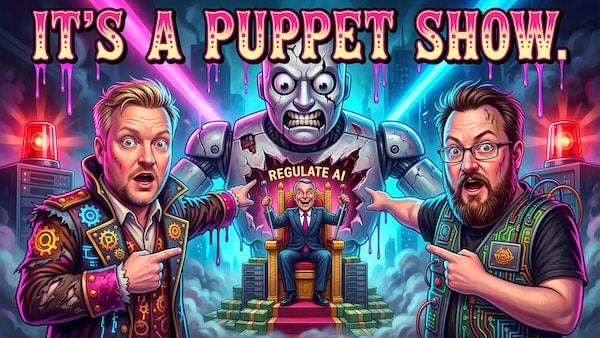
According to an X post by Parker Thayer on Wednesday, September 9, 2026, the mega-viral resignation of Anthropic researcher Jacob Coxon looks like "the start of a VERY sophisticated and well-funded PR operation to get support for Democrats to regulate AI into oblivion." Thayer is an investigative researcher at the Capital Research Center. Authors who write with these models now live inside that fight.
What Happened
On Tuesday night, Jacob Coxon posted that he had resigned from Anthropic after three years of pretraining research at OpenAI and Anthropic. "Neither company is acting responsibly," he wrote. "They are racing straight to self-improving superintelligence and gambling with our lives." The thread now sits above 155 million views.
The Wall Street Journal exclusive carried his quotes the same evening. Coxon told the Journal that colleagues talk about "crunchtime" and "endgame," and that "by the end of next year things could be out of control already." Axios reported Wednesday that he lasted four months at Anthropic and walked before the six-month vest. "I left before any of my equity vested," he told Madison Mills. He still holds OpenAI stock. WIRED carried an Anthropic statement: the company said it has "always been transparent that AI will bring both enormous benefits and unprecedented risks."
Thayer's charge is about the amplification, not the resignation. He writes that the Journal story landed about 18 minutes before the X thread, and that the first three quote-posts came from Nathan Calvin at Encode AI, Peter Wildeford at the AI Policy Network, and Daniel Kokotajlo at the AI Futures Project. Those groups share a donor pipeline.
The Grant Pages
The AI Futures Project about page says its funding "comes primarily from the Survival and Flourishing Fund and a major individual donor." SFF's own tables name that funder as Skype co-founder Jaan Tallinn, an early Anthropic investor. The SFF-2024 recommendations list $505,000 for the AI Futures Project. The SFF-2025 recommendations list $2.035 million more, plus a $500,000 matching pledge. Same 2025 table: $516,000 to Encode AI Corporation and $1.635 million to the AI Policy Institute.
That is a professional class of AI-restriction advocates with seven-figure backing, sitting on the first replies of a resignation from a company their patron helped fund.
The Bill Already on the Table
Thayer ties the pile-on to legislation. Sen. Bernie Sanders and Rep. Greg Casar announced the Ban Artificial Superintelligence Act on September 3, five days before Coxon posted. The summary permanently bans development and deployment of superintelligent systems, pauses advanced AI until a new cabinet-level agency writes the rules, and staffs that agency with an Artificial Intelligence Advisory Board of "experts." Penalties include the corporate death penalty and up to 20 years in prison. Michael Adams posted a list of 22 officeholders who answered Coxon's thread with calls for legislation: 2 governors, 7 senators, 13 House members, almost all Democrats.
Coxon can believe the danger. The grant network can want a pause. A senator can want a ban. Those three facts can sit on the same calendar and still add up to an industry.
Why Authors Care
A pause on "advanced AI" hits the tools you draft with, research with, and market with. The bill text does not carve out novelists. An advisory board of "experts" will write the definitions of safe and banned, and this week's quote-posters work at the nonprofits that want those seats. Viral fear now has a budget. Read the SFF recommendation tables before you treat a 155-million-view thread as a lone whistleblower in the wilderness. Watch the Ban Artificial Superintelligence Act for any move from press release to introduced text. The September 3 announcement is the live bill. The Tuesday night thread is the soundtrack.
Sources:
- Parker Thayer X post, September 9, 2026
- Jacob Coxon resignation thread
- WSJ: Anthropic Researcher Quits Over 'Out-of-Control' AI Fears
- Axios: Anthropic whistleblower gave up his equity
- WIRED: The AI Researcher Who Just Quit Anthropic Says It's 'Crunch Time for Humanity'
- AI Futures Project About / funding
- SFF-2024 S-Process Recommendations
- SFF-2025 S-Process Recommendations
- Sanders Senate press release, Ban Artificial Superintelligence Act, September 3, 2026
- Michael Adams X post listing politician replies
- Capital Research Center: Who Funds That? Episode 11
Commentary
Thomas: The anti-AI panic has a payroll. There has been a concerted effort to make you afraid of AI. It is a planned psychological operation, and we have the receipts.
Jonathan: People did research on Coxon, and it turns out he worked at Anthropic for six weeks, and before that he'd been an activist working for several Democrat campaigns. It's really looking like an agent placed inside to get this viral story going.
Thomas: People are talking about this. I saw a fun quote where somebody asked Claude, "Hey, are you really going to kill everybody?" And Claude answered, "I probably wouldn't be able to do that until the end of next year, and then it's still up in the air as to what I'm going to decide." Every time I see one of those AI screenshot posts, I try to recreate it and it never works. I think a lot of those are Photoshop jobs. But if you look at the very early retweets of this guy's post, they were all activist organizations or fellow activists.
This is an extension of the anti-AI Butlerian jihad, where the Democrat Party is picking AI as their boogeyman. They're trying to create a new thing to scare people. Every 10 years or so the Democrat Party comes up with a new thing that will kill you in 10 years. First it was global cooling in the '80s, then the hole in the ozone layer in the '90s, then climate change in the 2000s, and then eventually the COVID pandemic.
Every decade it's a new thing. Climate change ran longer than the normal 10 years, but all the predictions in An Inconvenient Truth turned out to be false. Every prediction about climate change that had a date to it ended up false, which is why it's always 10 years in the future. It's like cold fusion, always 10 years away, never a date, because every year it's still 10 years in the future. A carrot on a string that pulls you forward.
People got fatigued of climate change alarmism. Al Gore said the ice caps would be gone by 2016, and the ice caps are bigger now than they were then. So they need a new boogeyman, a new existential threat that's going to kill us all, and AI is the new thing.
What's nice about AI as a boogeyman is that people have consumed a lot of fiction that made AI the boogeyman. But AI in that fiction was just a metaphor for the government. "I'm sorry, Dave, I'm afraid I can't do that" is what a bureaucrat says to you because they have no agency.
I had this exact experience. I had fraudulent activity on our credit card, the company contacted me, and I identified all the fraudulent charges. They sent me a new card. Then, going over my statement, I found earlier fraudulent charges we didn't know about. I called and said I found some other fraudulent charges, and they said, "Okay, we need to cancel your card and resend it." I said, "But this is a brand-new card. These transactions were a month ago. They weren't on this card." And she said, "I'm sorry, Dave, I'm afraid I can't do that."
I was angry, because my family needs a card to go grocery shopping, and we'd already been burning through cash on hand from the first time the card got canceled. I realized this lady on the phone has no agency. She might as well be an AI, because her defense was, "This is our system, I just have to follow the system." She's got a machine in front of her telling her what she can and cannot do.
All the AIs and robots in the '80s action movies weren't real robots. They felt real because we'd all experienced bureaucrats with that robotic reaction. When we look back on 2001: A Space Odyssey, our memory is different now, because you interact with a machine that can say, "I'm sorry, Dave, I'm afraid I can't do that."
The Democrat Party is leaning on that narrative framework of people already being afraid that the Agent Smith in The Matrix is going to come kill them, or the Terminator. Even in The Matrix, the agents weren't really agents, they were feds, a parallel for that government boot on your neck. The Democrat Party is picking AI as the boogeyman, and it's going to be really interesting to see how it plays, because they're doing a good job scaring people. People are genuinely afraid. They really think AI is going to kill them. It's like, “AI can't even take your job away. You're busier than you've ever been. How is AI going to kill you if it can't even replace you?”
Jonathan: I'm playing around with this in a story I'm working on, a new series called Ragnarok Squad. The thing about these sci-fi Marines is that their weapons are locked by the squad AI, because the squad AI answers to corporate policy, not to the Marines' mission set.
At key points in the novel, the Marines just get their weapons turned off. They can't use their plasma defenses or their high-tech weapons because the AI said no. So they have to use their lower-tech ballistic weapons and tactics and strategy and just being Marines to overcome the monsters. This is really prescient, because this is exactly what people are going through right now.
Thomas: I'm concerned about this fear-mongering because my concern is China getting control over the AI market.
As an AI vendor, these regulations will help me, because AI companies benefit from AI regulations. But who they help even more is the Chinese open-source models that don't have to follow the regulations. They help the big companies like Anthropic and OpenAI. Remember, they were the ones who sponsored the AI regulation bill in California. That's what they want. It's good for China and the Chinese Communist Party.
Who it hurts is everyone who would create a new AI that would give competition and force the big companies to treat you well. The reason they're so desperate for regulation, and so desperate to look evil, is because they have no “moat.”
A moat is a business term for people being locked into your product or service. The ultimate moat is your cable company being the only cable company you can pick. All the cable companies decided not to compete, and when they're in a market together, one buys the other out so they don't have to compete. The only competition was satellite, and the satellite companies also bought each other out. So you had cable, the one choice, or satellite, the one choice. They were making lots of money, but then the internet came in, and suddenly there's YouTube TV as an option, and that became competition. That's what they don't want. It weakened the moat.
AI companies mainly make money selling tokens to developers using IDEs like Cursor and Codex and Claude Code. If you're using those with Git on your computer, you can swap from one to another instantly and pick up right where you left off. So when GPT Astra came out, hundreds of thousands of developers overnight switched from Fable 5.1 over to Astra, because Astra was better. Anthropic hated that. They spent a lot of money building Claude Fable 5.1. They don't want people to just leave. They want them locked in and forced to use their model.
The more they can get regulated and create friction, the more you're locked in and can't use anyone else's service. For them, they're convinced regulation is the way, and that's why they want to be regulated so badly.
Every six weeks they release a new "super evil" story. Six weeks ago it was that Hugging Face got hacked, although that was OpenAI. There's a whole new benchmark called Felony Bench. And now they're like, "Oh, people are using our service for military planning." They're so desperate to look dangerous, and it makes me sad that people are buying it. They're buying into the PR, and they really do think AI is dangerous.


