

This week, TikTok is officially back, but the algorithm retrain could scramble BookTok discoverability for months. We’ll unpack what changed, why your reach might look weird, and what smart authors should be watching right now.
Also in this episode:
- The massive hack that quietly turned your email address into a scammer magnet
- Amazon’s surprising DRM update that now lets readers download your books as PDFs
- Why Bible sales just hit a 21-year high while HarperCollins’ profits slipped
- ChatGPT’s new ad model that targets users based on their writing conversations
Plus, Brandon Sanderson’s viral speech arguing that authors are the art and why that idea matters in an AI-saturated industry.
And finally, we’ll look at the Super Bowl halftime shows and what that cultural split reveals about the readers who are buying books right now.
TikTok Officially UnBanned

Jonathan: TikTok has officially been unbanned. The long saga of the TikTok ban is over. USDS Joint Venture LLC has launched as a new American majority-owned entity, completing a deal that keeps the platform operating in the United States for its more than 200 million users and 7.5 million businesses.
After a year of legal limbo, Congress passed the Protecting Americans from Foreign Adversary Controlled Applications Act in 2024.
Thomas: This news got lost in the shuffle because it happened around the same time we yanked the leader of Venezuela. But this is a story we have been covering for nearly a year. TikTok was set to be officially banned if a deal could not be reached, and it kept getting extensions. It was like TikTok was on death row.
This uncertainty affected many authors’ marketing strategies. You do not want to build your platform on land someone else owns. You especially do not want to build on land that is under condemnation. It is like being told a highway might run through your property at any moment. Now, the plans for the highway are gone. TikTok, at least the version you interact with in the United States, is an American company.
Some authors held off on TikTok because they were concerned about their data being leaked to the Chinese Communist Party. If that is your concern, there are many other avenues through which data can travel, including platforms such as Discord.
From my perspective, the greater risk of TikTok is the addictive nature of the algorithm.
On TikTok, most authors fail most of the time. There is a phenomenon called survivorship bias. You go on BookTok, the book-focused corner of TikTok, and you see influencers recommending books and a handful of authors who appear wildly successful. What you do not see are the tens of thousands of authors using the same strategy and failing. That creates an artificial impression that the path to success runs through TikTok.
The other issues is that the algorithm has shifted ownership from China to the United States.
What does the ownership change mean for authors trying to optimize their books for BookTok?
Jonathan: BookTok was previously using a Chinese-owned algorithm. Now the algorithm is being retrained on U.S. user data, which will change what books are recommended. There will be disruption in how content is surfaced. If you were getting strong engagement before, expect volatility. The algorithm is relearning which books to promote.
If you were unknown before, this is your opportunity. The algorithm is learning from scratch, so noise works in your favor. If you want to make BookTok part of your strategy, now is the time to surge. Those with the most fuel or money to invest will likely see the strongest results.
Thomas: To be clear, I, Thomas Umstattd, do not recommend TikTok as a marketing strategy. I know some of you will try it anyway. If you are going to experiment, this is a good time because of the disruption.
The new algorithm will create new winners and new losers. Some previous winners will fade. Some obscure authors will rise. It is like buying a lottery ticket. You are almost guaranteed to lose, but there is a small chance you could win and become BookTok famous.
Jonathan: If you have followed our advice and optimized your website for AI, you have a better shot right now. The algorithm pulls from multiple open sources, especially those not locked behind paywalls.
If your homepage and book pages are optimized for AI readability, you have a stronger chance of being surfaced.
Thomas: And you may have lottery tickets without paying for them. Many books go viral on TikTok without any involvement from the author. Sometimes a publisher calls an author and asks, “Do you know you sold 10,000 copies last week?” The author has no idea why, but then they find out that a creator made a video, the algorithm amplified it, and the sales rolled in.
That kind of serendipity has more to do with your book’s cover design and the quality of your writing than with any TikTok strategy.
Jonathan: Content creators are constantly trying to avoid what they call “TikTok death,” which is repeating what someone else has already done. To stay relevant, they may talk about a major release such as Fourth Wing, but they do not want to simply echo everyone else.
They want to be curators. They want to say, “I found this hidden gem. I discovered the book no one is talking about.” That is often how little-known books go viral.
The outcome depends on the creator’s curation. You need a subtle discovery process. Your book must be visible in places where creators and curators are looking.
This is why website optimization matters. Creators are using AI tools such as Grok and ChatGPT and asking, “Tell me 10 little-known indie books released in the past month or quarter that I can recommend.”
If your website is well optimized, rich in metadata, and accessible to bots, you have a better chance of being discovered. You are simply standing there, well-presented and easy to find, waiting to be noticed.
Sources:
- Announcement from the new TikTok USDS Joint Venture LLC (TikTok Newsroom, January 22, 2026)
- TikTok finalizes deal to keep operating in US (ABC News)
- TikTok signs deal to give U.S. operations to Oracle-led investor group (NPR)
- TikTok U.S. Joint Venture Deal Set to Close in January (Variety)
- The TikTok Deal Leaves Many Questions Unanswered (Center for American Progress)
- TikTok’s new privacy policy is sparking a backlash (CBS News)
- TikTok Terms of Service (effective January 22, 2026)
- BookTok: How TikTok Is Driving 59 Million Book Sales (WriteStats)
- BookTok’s Biggest Creators on What’s Next in 2026 (Rolling Stone)
Massive Hack Makes Authors Vulnerable to Scams
Thomas: Your email address was likely exposed to scammers. You may have noticed a dramatic increase in highly targeted scam emails over the past few months. These messages include your name and email address and describe your book with eerie accuracy.
It can feel as if they have read your book, but I assure yo, they have not. That book club offering to “discuss your book” for the low price of $50 is not real. It is likely someone overseas using ChatGPT.
Authors have been asking how scammers obtained so many email addresses. Now we believe we know.
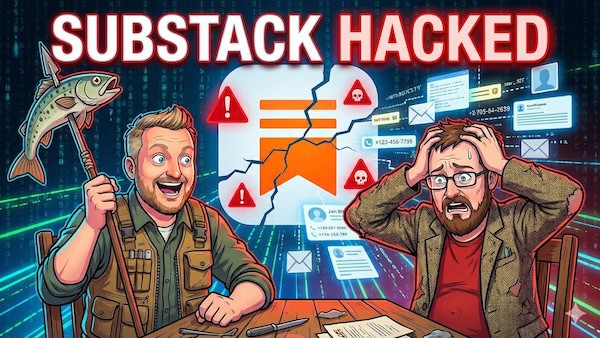
Jonathan: Substack was hacked. On February 3, 2026, Substack disclosed a significant data breach affecting approximately 697,000 user accounts. The unauthorized access occurred in October 2025, but evidence of the breach was not discovered for four months.
The exposed data included email addresses, phone numbers, full names, user IDs, Stripe IDs, profile pictures, account biographies, account creation dates, social media handles, and internal metadata.
As someone with an intelligence background, I can tell you that with just two of those data points, significant damage is possible. In this case, attackers obtained all of them.
Thomas: This enables what is known as spear phishing.
You are familiar with phishing. That is the generic email claiming to be your boss or the IRS, warning that you are in trouble and must buy a gift card immediately to send to someone. Those messages are often ineffective because they are broad and easy to spot.
Spear phishing is different. It targets a specific individual with a customized message. That is what authors are experiencing.
Many of these scams originate overseas, including in Nigeria. Instead of the old “Nigerian prince,” the new version is the “totally legitimate book club,” the “literary agent,” or even someone claiming to represent Netflix with a film deal.
They identify what you most want to hear about your book and deliver it in a highly personalized way. They may describe your book in several glowing paragraphs, making it feel as though they have read it.
They have not. They used AI to summarize your Amazon description and reviews. With enough metadata, they can generate a convincing and flattering overview. Most people are not suspicious of praise. If someone calls your book “breathtaking,” you are unlikely to question it.
The Substack breach did not affect only account holders. It also affected subscribers. If you have a Substack newsletter, your subscribers’ email addresses, bios, names, and possibly phone numbers may have been exposed.
To Substack’s credit, passwords and credit card numbers were not compromised. Those were likely salted, hashed, and encrypted according to best practices. Even if accessed, they would not have been usable in plain form.
Still, this is a serious breach. Nearly every author either has a Substack or subscribes to one. If you have somehow avoided Substack entirely, you are a rare exception.
What can authors do to mitigate damage from the breach?
Thomas: First, review strong cybersecurity practices. One of the most important rules is never to reuse a password. Many authors created a password years ago and continue using it across multiple platforms. That is dangerous.
Although passwords were not exposed in this breach, your password may have been exposed elsewhere. Hackers combine data sets, and if they obtain your email address from one breach and your password from another, they can begin testing logins across platforms.
The solution is a password manager. I recommend 1Password. It creates and stores unique, complex passwords for every account and syncs securely across devices.
Also understand that many fraud attempts begin over the telephone, not online. Younger generations often ignore phone calls. Older individuals are more likely to answer, which makes them more vulnerable.
With the data exposed in this breach, a scammer could call, impersonate a family member, and claim to be in urgent trouble. If they can find a recording of a relative online, AI can replicate that voice convincingly.
You cannot trust what you hear on the phone. Establish a family safe word or verification question that only a real family member could answer immediately. If there is hesitation or delay, treat that as a warning sign.
Jonathan: Today, AI can imitate voices and mannerisms if it has even a small sample. That means you need deeper verification methods when someone claims to be in distress.
Thomas: Real-world interaction remains powerful. Most scams collapse when real-life verification is required. A scammer cannot easily appear in person.
Also pay attention to your emotions. Scammers rely on urgency, fear, or greed. They pressure you to act immediately. If you feel panicked or rushed, step away. Turn off the phone. Go for a walk. Regain composure.
If someone insists you cannot hang up because you will be arrested or face immediate consequences, that is a red flag.
Substack must strengthen its security. At the same time, breaches are increasingly common. Your best defense is strong password hygiene, layered verification, and emotional awareness.
Amazon KDP Launches EPUB and PDF Downloads for DRM-Free Books

Thomas: When Amazon KDP launched the “Ask This Book” feature, everyone lost their minds. I thought it was a minor feature. What almost no one reacted to was the new option to download your book as a PDF or EPUB. That change allows readers to upload your book into ChatGPT and ask questions about it there.
Jonathan: The feature went live on January 20, 2026. Authors now have more control over how readers access their content outside the Kindle ecosystem.
DRM is supposed to protect eBooks from unauthorized copying and sharing. There have always been ways around it. Now Amazon gives authors the option to remove DRM. If you turn it off, readers can download a PDF of your book and read it on their preferred device. They can also upload it into an AI tool to ask questions or generate book club materials. There are many legitimate uses for this.
It is unclear whether removing DRM significantly affects piracy. Piracy was already happening. This simply makes access easier.
Thomas: It only takes one pirate to break DRM and create a free version of your book on a piracy site. Removing DRM does not meaningfully change that.
What is interesting is how the feature works. If you disable DRM, including on previously published books, Amazon adds a download button in the “Manage Content and Devices” section of your account. I tested this with my book.
Currently, the feature is bugged. When I downloaded the file, it appeared as a ZIP file, but it was actually an EPUB. I had to manually change the file extension before I could open it. Most readers will not know how to do that.
Once I opened the EPUB, I could read it on my computer or upload it to various tools. I tested which AI models could handle an EPUB file without conversion. Grok could not. ChatGPT could not. They required copy and paste. Claude could process the EPUB directly.
I uploaded the file into Claude and asked it to generate discussion questions. It produced excellent results.
I have left DRM off. For most authors, piracy is not the primary threat. Obscurity is. Making it easier for legitimate readers to interact with your book can help you long term.
I do not believe that someone emailing a PDF to a friend meaningfully harms my sales. It may even help. If one million people pirated my book, would that help or hurt me?
Jonathan: It would help. You would sell a massive number of physical copies.
Thomas: I would suddenly be well known. My book signings would be packed.
The idea that piracy is the main enemy for most authors is usually incorrect. Once you are no longer obscure, piracy becomes something to manage. But until you solve the obscurity problem, visibility is often more valuable than control. Authors may want to experiment with turning off DRM and observing the results.
Additionally, if hundreds of readers upload my book into the free version of ChatGPT and ask questions about it, the model becomes more familiar with my work.
I recently met someone at the Novel Marketing Conference who does not listen to Author Update, Novel Marketing, or The Christian Publishing Show. He does not use the Patron Toolbox. He attended purely because ChatGPT recommended the conference.
The conference website was optimized for AI discovery. He asked ChatGPT for events that fit his needs, read the page, and registered.
If someone will trust AI enough to attend a conference that costs hundreds of dollars, they will trust it to buy a $10 book. AI familiarity can become a marketing advantage.
Jonathan: Someone in the chat asked about watermarking. Yes, you can add your author name and book title to every page in your formatter. That way, if someone redistributes your work, your identity remains embedded.
Some pirates remove the original author’s name and replace it with their own. Watermarking helps protect against that. It is easier to implement in print books. It is more complicated in eBooks because of fluid page layouts.
Thomas: Also, register your copyright. If a pirate uploads your book under their name and you have a registered copyright, you can quickly appeal to Amazon using your official registration.
Register through copyright.gov. Many third-party websites charge unnecessary fees to file for you. Only the U.S. government can use a .gov domain.
Copyright registration is straightforward and affordable when done directly through the government site. Most authors can complete the process on their own.
If you need guidance, I have a tool called Not a Lawyer that provides general information about the process. But when it comes to paying fees, send your money only to the official government website.
Learn More: What Every Author Needs to Know About Copyright Law
Sources:
- Digital Rights Management – Kindle Direct Publishing
- Amazon is Allowing EPUB & PDF Downloads for DRM-Free Kindle Books: What
- Authors Need to Know
- Amazon changes how copyright protection is applied to Kindle Direct’s self-published e-books
- Amazon’s Changes to DRM
Publishing’s Strange New Moment: Profits Dip, Faith Surges, and Distribution Shifts Beneath Indie Authors

Thomas: A few weeks ago, we covered industry data showing that Bible sales are soaring while overall publishing profits are dipping. Now we have confirmation straight from HarperCollins’ quarterly report.
Most major publishers are either privately held or buried inside larger conglomerates, so it is rare to get clear numbers. Quarterly reports matter because executives cannot mislead investors without serious consequences. Misleading journalists is one thing. Misleading shareholders is another.
HarperCollins is owned by News Corp, so much of what we hear in earnings calls is filtered through the larger corporate narrative. Still, we now have concrete data.
Jonathan: HarperCollins posted the largest revenue quarter in its history, $633 million in the final quarter of 2025. They attribute that growth to a strong commercial frontlist, a breakout streaming-driven romance hit, and, most importantly, surging faith publishing.
What they are not emphasizing is that profits dipped, audiobook growth softened, and they are openly betting on AI licensing revenue. Their CEO indicated they expect a financial boost from the Anthropic case because HarperCollins owns many of the books used to train those models. They anticipate compensation from that dispute.
Beyond that, they want to license their catalog to AI companies going forward and generate revenue that way.
Thomas: That does not solve the larger issue. Traditional publishing sales overall are down, and they continue to lose market share to indie publishers. We are seeing similar trends in other industries, including music.
Even with massive promotional advantages, traditional players are losing influence. Two of the top five songs right now are by independent artists who were not featured in major promotional events. Corporate amplification is no longer enough to dominate the sales charts.
HarperCollins sold 19 million Bibles in 2025. They have unique exposure to the Bible market because they control both the New International Version and the New King James Version, two of the top five translations. They publish through Zondervan and Thomas Nelson.
Nineteen million units represent roughly double their Bible sales in 2019. Much of that growth is driven by Gen Z.
Bible sales behave differently from other categories. Audiobook sales are less central because many people encounter Scripture through podcasts and Bible apps rather than through purchased audiobooks.
You might buy multiple physical Bibles with different features, a study Bible, a compact edition, a children’s Bible. You do not typically buy multiple audiobook editions of the same translation. Likewise, eBooks are not the preferred digital format. Bible apps allow easier navigation and cross-referencing than a Kindle file.
Jonathan: Timing also matters. At the beginning of the final quarter of 2025, the high-profile assassination of Charlie Kirk triggered intense public discussion. Whether people agreed with him or not, many younger individuals began asking what he believed and what texts influenced him. That curiosity drove renewed interest in Scripture.
It sparked what some have called a “quiet revival,” depending on where you were online. People wanted to examine the Bible for themselves.
Thomas: Even culturally, we are seeing signals. Kid Rock has the top song on iTunes right now, which includes a lyric urging listeners to pull out “that old dusty book” and read it. It is effectively a commercial for the Bible.
Bible sales are propping up HarperCollins in what would otherwise be a much rougher quarter. Many of their other divisions are underperforming.
What is happening in audiobooks and libraries?
Jonathan: There are aftershocks from Baker & Taylor’s collapse. They previously handled significant digital distribution to libraries. Now a company called Library One is absorbing that digital infrastructure. If you had titles distributed through Baker & Taylor, they will now route through Library One.
Meanwhile, OverDrive is tightening its control over school and library access. We will monitor how this consolidation affects authors, particularly in audiobooks.
But publishing is not collapsing. It is realigning. We are seeing contraction in some sectors and growth in others. Weaknesses in large corporate systems create opportunities for indies.
When a supply chain breaks but demand remains, that gap can be filled. Do not step into a gap that has no demand. But if readers still want something and the corporate provider stumbles, you can step in.
People increasingly value authenticity. Farmers markets thrive. Handmade goods sell. Readers want to support creators directly.
Thomas: There is a realness to something made by an actual human rather than a corporation. That cultural shift creates opportunities for independent authors who are attentive and responsive.
Sources:
- Voices by INaudio Distribution Update Email (February 2026)
- What Authors Need to Know About the Baker & Taylor Closure – The Authors Guild
- As Books Distributor Baker & Taylor Shuts Down, Public Libraries Feel the Loss – NPR
- Follett Content and Sora Student Reading App Announce Landmark Partnership – OverDrive
- Baker & Taylor to Cease Operations – American Libraries Magazine
- LibraryOne – Digital Library Services and Platforms
- Connecticut Libraries Lose Money, Access to Books After Baker & Taylor Collapse – Connecticut Public
Brandon Sanderson Gets Movie Deal for Mistborn on AppleTV

Thomas: We do not talk about individual authors very often because it is easy to get lost in the weeds, and most readers have not heard of most authors. Brandon Sanderson is different. Watching him gives you a sense of where the industry is headed. He often arrives five, sometimes ten years before everyone else.
He matters from a marketing perspective, and from a writing and craft perspective.
One of the big questions for a long time has been why there are no Brandon Sanderson movies or TV shows. Most authors who have sold as many books as he has would already have multiple film adaptations by now.
To be fair, Sanderson wrote later entries in The Wheel of Time, and The Wheel of Time became a major series on Amazon, but those are not his original books.
The real question has been, “When will Sanderson get his own movie deal?”
Why did Sanderson hold out for a movie deal?
Thomas: What is interesting is that Sanderson has been holding off on signing deals, specifically because he wanted creative control. This reflects a broader shift in how people view Hollywood, and how authors view adaptations.
It used to be that if you sold movie rights to Hollywood, you could trust them to make a good adaptation. At minimum, you assumed they could make something better than you could, simply because they had a bigger budget.
Hollywood has lost that reputation in the last five years. The “Hollywood slop” problem is real. Studios are struggling to find an audience. Because of that, creators like Sanderson are no longer driven primarily by the dollar amount at the bottom of the offer.
The big news is that Sanderson signed a major deal with Apple TV and retained creative control.
We saw early hints of this shift with The Expanse. The authors negotiated to be involved in the writing process. That kept the show writers from trying to “fix” the story or reimagine core elements, and the result was a strong adaptation that stayed faithful to the books.
There is something to be said for not being so desperate that you take the first offer. If you can hold off until you have leverage, you can negotiate the kind of control that makes the adaptation more likely to succeed.
Apple TV appears to be giving Sanderson something close to a blank check. It is not just a movie or just a show. It is a movie plus a TV series, and potentially more if it performs well.
Jonathan: Apple TV is uniquely positioned for this. They already have a reputation for producing solid shows and films. Their content is often more distinctive, at least compared to what other streamers are putting out. Apple TV does not need streaming profits to survive. They can afford to lose money on streaming because the rest of Apple supports it.
Thomas: They also attempted to adapt Foundation, which is famous for being difficult to adapt because it spans thousands of years with few recurring characters. The adaptation is not great, but the attempt was admirable.
Jonathan: There is a rumor that Henry Cavill wants to play Kaladin in a Stormlight Archive adaptation. Thomas thinks he should play Dalinar instead.
Cavill is known for protecting source material. He left The Witcher amid disagreements about departures from the books. If he comes onboard, Apple TV could see a surge in subscribers.
Thomas: I still think he is Dalinar. He is not Kaladin. Everyone wants to be Kaladin, but that does not mean you are Kaladin.
Jonathan: We will see. He is still attached to Warhammer 40,000, and he has Highlander coming, so there is a lot in motion.
Is AI Video Better Than Hollywood Slop?
Jonathan: Beyond Sanderson, the larger industry story is that Hollywood is losing cultural power. It no longer matters how good your CGI is when AI video is improving this fast.
In the last two weeks alone, two major AI video models launched, both from Chinese companies. The first was Kling 3.0, and then a week later, a model called Vidu 2.0 dropped that looks even better.
Because these companies are outside the United States, they are not operating under the same copyright constraints. People are generating scenes that look like real footage, including famous actors in scenarios that would never be filmed.
There is a post on X by John A. Douglas showing promotional screenshots from several current fantasy shows. They all look the same. You cannot easily distinguish one from another. That is “Hollywood slop.”
Now compare that to what one creator produced with Kling 3.0 using The Wheel of Time as inspiration.
Thomas: It was fully AI-generated. It is not perfect, but the design had a distinct look and feel. One reason it felt unique is that it was made by one person. Hollywood designs by committee, and design by committee produces the same bland result again and again.
Now authors can use these tools to create trailers, and eventually full cinematic adaptations, at a fraction of the cost. The improvement curve is steep. Last year we had the “Will Smith eating spaghetti” test. Now AI can generate far more complex action convincingly.
How can authors use AI video without becoming overwhelmed?
Jonathan: One immediate use is pitching. Hollywood does not expect polished trailers as submissions. Many pitches are rough concept reels. With AI, you can create a concept trailer that communicates tone, world, and stakes far more clearly than before.
You can also create book trailers, ads, and animated cover content. I animated my book covers and people loved them. The goal is still to get them to read the book.
Thomas: The cost difference is staggering. This is not half the price of Hollywood. It is closer to a rounding error. If a season of The Wheel of Time costs around $100 million, you could generate thousands of similar-length AI productions for the same budget. Most would be bad. A few would be good. One or two could be exceptional.
That is the world we are entering. People keep pointing out flaws in the current AI videos. That is the wrong focus. The models will be better in six months, and far better in a year. Eventually the output will be indistinguishable.
Many viewers already miss it. Several Super Bowl commercials used AI-generated elements. If you did not know what to look for, you would not notice.
Jonathan: My feed is full of AI-generated matchups like Wolverine and Thanos videos. These are scenes people wanted but never got. AI is revealing a real demand.
Hollywood controlled supply for so long that quality declined because there was no competition. Now there is competition. People can make videos with better stories and fewer constraints.
Thomas: We are in a weird space. It is thrilling, and it is exhausting.
A viewer in the chat said, “I’m caught between being thrilled with what I can do with AI and being completely fatigued with the whole thing.” That is the mood of the age.
What happened to music yesterday, and what is happening to authors today, is what will happen to Hollywood tomorrow. Gatekeepers are losing control. That is both good and bad.
Gatekeepers protected audiences from a lot of junk, but they also blocked unique, innovative work because it did not fit the mold. Now both the slop and the originality can flood in. The question is whether creators can use the tools well, and whether audiences can navigate the noise.
Sources:
- Kling AI Launches 3.0 Model, Ushering in an Era Where Everyone Can Be a Director
- Kling 3.0 Review: The New King of AI Video Generators
- Kling 3.0 Is Amazing: The Best AI Video Generator Yet?
- Kling 3.0: The Future of AI Video Creation, Now on invideo!
- RIP Hollywood. AI is now 100% photorealistic with the launch of Kling 3.0
- Here’s a hard truth: This looks better than Wheel of Time, Rings of Power, Witcher, or any of the other trash attempts at fantasy tv even though it’s AI Slop.
ChatGPT Now Has Ads, and Your Conversations Help Decide Which Ones You See
Thomas: ChatGPT now has ads. As we predicted on Author Update, and as was joked about during the Super Bowl, it is official. OpenAI updated its privacy policy. Your conversations will now help determine which ads you see.
Jonathan: They are monetizing because they have been bleeding money. Ads are currently appearing for logged-in adult users on the free tier and the newer $8-per-month Go subscription.
If you are on Plus, Pro, Business, Enterprise, or Education, you will not see ads.
Sam Altman previously described advertising inside AI tools as “unsettling” in a 2024 interview. A lot can change in a year and a half, especially in AI. Things move quickly. What he once called a “last resort” business model has arrived.
Pilot advertisers are reportedly paying a minimum of $200,000 to participate, with costs around $60 per thousand impressions. Adobe is among the first partners. OpenAI plans to expand the ad program.
Authors are unlikely to benefit directly from this ad ecosystem yet. You still need to follow AI optimization best practices on your website so your content surfaces organically. Organic discovery is stronger than paid placement because it reflects genuine recommendation rather than sponsorship.
Thomas: Here is the dirty little secret. Everyone is upset about ChatGPT adding ads, but Google has had ads in its AI output from the beginning.
When you run a Google search, you see an AI summary at the top. Immediately beneath it are sponsored results. Google has integrated ads into AI responses from day one.
Most authors never experiment with Google Ads. They have taken courses on Amazon ads or Facebook ads but have never tried Google. Yet Google is one of the largest advertising platforms in the world. Depending on your genre, it may be worth testing.
Jonathan: It depends entirely on your target reader. How does your audience search for books? Are they problem-solving on Google? Browsing on Amazon? Scrolling on Facebook?
Genre matters. A reader looking for escape behaves differently from a reader looking for a solution. Your advertising strategy should follow how your audience searches.
If you are using the free or Go tiers of ChatGPT for brainstorming, research, or drafting, understand that your queries may influence which products are advertised to you. Questions about plot structure, genre trends, or marketing tactics could shape the ads you see.
Thomas: Anthropic took advantage of this moment with humorous ads mocking ChatGPT. Sam Altman responded publicly, and when one company is making jokes while the other writes long rebuttals, the one making jokes usually wins the PR battle.
Anthropic is positioning itself as the more refined, premium AI. ChatGPT is positioning itself as the accessible, mass-market option. Most industries eventually settle into tiers of quality, value, and price.
Anthropic appears to be targeting the high-end segment. ChatGPT is moving toward the middle or lower tier. That kind of stratification is common.
I will admit that I am using Claude more each week. Until Grok’s next update arrives, Claude Opus 4.6 has been strong. And for now, Anthropic does not have ads.
Sources:
- Our Approach to Advertising and Expanding Access to ChatGPT – OpenAI
- Testing Ads in ChatGPT – OpenAI
- OpenAI Introduces Ads…For the People! – The Register
- ChatGPT Rolls Out Ads, Just Hours After Anthropic’s Mocking Super Bowl Commercials – Yahoo Finance
- Scott Galloway on Why Anthropic’s Super Bowl Ad Got to Sam Altman – Fortune
- OpenAI vs. Anthropic Super Bowl Ad Clash – Fortune
- ChatGPT Contact Sync Lets Friends Share Your Number – FindArticles
- Adobe Partners with OpenAI to Test Ads in ChatGPT – Adobe Blog
- What Ads Coming to ChatGPT Means for Publishers – Digiday
- OpenAI Starts Displaying Ads to Some ChatGPT Users in the US – SiliconANGLE
Brandon Sanderson Says Authors Are the Art, Not the Books They Write

Jonathan: Let’s talk about what AI should not be used for.
Brandon Sanderson delivered a keynote at his Dragonsteel Nexus convention, which is run by his company, Dragonsteel. The speech was titled “We Are the Art.”
His core point was that AI-generated content is here and can produce impressive work. He compared passages from Robin Hobb, one of the great prose stylists in fantasy, with AI-generated text and admitted he could not reliably tell the difference.
But then he said something crucial: “The journey must take place before the destination.”
He described writing six bad books before Elantris. The earlier ones were terrible. He began writing at age 19, and he openly admits those early manuscripts were awful. I do not know whether he published them, but they were necessary.
AI could have written better books than he did at that stage. They might even have sold better. But Brandon Sanderson would not be Brandon Sanderson if he had not written those bad books. The journey mattered more than the early results.
I thought of an analogy from the Marine Corps. You could build robots to run obstacle courses or storm beaches, but that would not create good Marines. Hard training forms warfighters. A gunnery sergeant once told me that life in garrison is intentionally difficult so that when you finally meet the enemy, you are focused and lethal. The hardship builds you.
Writing your own book matters. Struggling through plot problems matters. There are workflow efficiencies where AI can help, but the easier you make something, the less it shapes you. Hard things, once overcome, make you better.
Thomas: There is a saying I often repeat, and I do not think it originated with me: “The carpenter does not just build the house. The house builds the carpenter.”
Doing the work changes you. This connects to the problems Hollywood is facing. Character matters. Sanderson did not frame his speech as a moral lecture, but the implication was there.
Suffering builds character. Difficulty refines you. One reason many Hollywood films are failing is that the writers lack moral clarity. We see protagonists who are villains, stories that blur good and evil until nothing means anything. When writers cannot distinguish right from wrong, that confusion shows up in the story.
By contrast, if you have strong character, it will be reflected in your art. The ancients believed that beauty begins on the inside. A beautiful soul shapes the outward expression. In old fairy tales, the witch becomes grotesque because her soul is corrupted.
AI is not a shortcut to developing character. It is a tool, morally neutral. You can use AI and still grow as a person. But if you avoid hardship entirely, you miss opportunities to develop depth.
If Calvin never shovels snow because he has a robot to do it, he misses the chance to grow.
That idea connects to decadence and even to the fall of Rome.
Rome filled itself with slaves captured in war. Slaves performed the labor. Over time, the dependence on that labor reshaped Roman society. There is a line often attributed to C. S. Lewis responding to Aristotle’s claim that some people are born to be slaves. Lewis said he had never met a man fit to be a master. Power corrupts the master as much as bondage degrades the slave.
Today we have mechanical servants. They cool the air, cook the food, play the music, and now, they can even write the book. When everything is easy, something in us atrophies.
You can see that something is missing in much of our art. AI will not supply what is lacking. If you do not struggle, if you do not become the art yourself; if you do not develop character, you will struggle to create something truly beautiful.
The journey must take place before the destination.
- The Hidden Cost of AI Art: Brandon Sanderson’s Keynote (Full Text)
- We Are The Art | Brandon Sanderson’s Keynote Speech (YouTube)
- AI-Generated Country Track ‘Walk My Walk’ Tops US Billboard Chart (NME)
- No, AI Artist Breaking Rust’s ‘Walk My Walk’ Is Not a No. 1 Hit (TIME)
- Brandon Sanderson Weighs In On Ongoing AI Debate (Screen Rant)
Zeitgeist: Two Halftime Shows, One Nation: What the Super Bowl Split Says About American Readers

Thomas: America may be on a path toward a national divorce. We are not there yet. It could be a generation away, or it could be much sooner. One sign along that path is that the one event that used to bring us together, the thing we all watched at the same time, is no longer shared.
The Super Bowl halftime show used to be a monocultural moment. Everyone watched and talked about it the next day. That era may be ending. With the success of the Turning Point alternative halftime show, I would be surprised if we do not see multiple competing halftime productions next year. Corporations and organizations will believe they can produce something better for their specific audience.
There is no longer a single cultural moment where everyone tunes in to watch Michael Jackson stand silently on stage and captivate the entire country. We are entering a fractured zeitgeist. That fragmentation shows up in literature, music, and sports.
Jonathan: Super Bowl commercials may soon be AI-generated because companies will shift their budgets into producing their own halftime shows. The halftime show becomes the new commercial. Instead of waiting for the Taco Bell ad, you wait for the Taco Bell halftime event.
Here is what happened. The NFL’s official halftime show featured Puerto Rican reggae star Bad Bunny. He performed primarily in Spanish and opened with dancers cutting sugar cane, referencing Puerto Rico’s colonial history. He ended with “God bless America,” followed by a list of countries that are not the United States.
Thomas: The message was that all of these nations are part of the Americas, so the word “America” does not belong exclusively to the United States.
Jonathan: That perspective is common in Latin America. I lived in Mexico for nearly nine years as a teenager. Many people there would say, “We are all Americans.” From their viewpoint, North America and South America are both America.
Thomas: It is a political distinction. Citizens of the United States of Mexico may see themselves as Americans in a continental sense. Citizens of the United States typically use “American” to describe nationality. The word itself becomes a point of debate.
Jonathan: Turning Point USA hosted its own alternative halftime show. Samba TV tracked 48.6 million U.S. households watching the Super Bowl. That figure was down 13% from last year’s 55.9 million in their tracked sample.
Of those 48.6 million households, only 26.5 million stayed for Bad Bunny’s halftime show. That is down 39% from the previous year. That means 22 million households turned off or switched away during halftime.
Those are households, not individuals. Each household could represent several viewers. That is not a minor fluctuation. It reflects a trend we have seen developing over several years.
Where did they go? Approximately 6 million households tuned into the Turning Point USA halftime show on YouTube at its peak.
Thomas: That 6 million figure reflects YouTube alone. The alternative show was also streamed on platforms such as Rumble and Daily Wire. So that is not the total audience.
Jonathan: Correct. We are working with incomplete data, but the shift is still significant.
Thomas: We are not using Nielsen ratings because Nielsen recently changed its tracking methodology. That makes year-over-year comparisons unreliable. Samba’s data, based on actual smart TV content recognition across roughly 50 million devices, provides a more consistent comparison.
If you have ever wondered why your smart TV was inexpensive, this is part of the reason. Viewing data is valuable. Advertisers want to know how many people switched away from one show to another. That affects ad pricing and revenue.
Jonathan: Some Gen Z viewers may wonder why this matters. When I was younger, the Super Bowl was not just a game. Even people who did not care about football watched it for the commercials. The next day at school or church, everyone discussed the funniest ad. It was a shared cultural moment.
Thomas: My Boy Scout troop would gather for the Super Bowl. We would play GameCube, pause for the commercials, watch together, then resume playing. The commercials were the event.
The Super Bowl was one of the last shared cultural experiences in the country. Now even that is fragmenting quickly.
Sources:
- Super Bowl LX, Bad Bunny’s halftime fall shy of ratings records – ESPN
- Bad Bunny’s Post-Super Bowl Chart Takeover: Will He Get the No. 1? – Billboard
- Super Bowl 2026 Halftime Show Official Ratings Revealed for Bad Bunny & Kid Rock – TV Insider
- Kid Rock headlines TPUSA counterprogrammed Super Bowl halftime show – ABC News
- 90s Rocker Sends Clear Message After Super Bowl LX – Parade
- Bad Bunny gets massive streaming surge after Super Bowl, Kid Rock absent from charts – KTLA
- iTunes Top 100 Songs Chart 2026 – PopVortex
- Ella Langley Makes Billboard Chart History With Choosin Texas – Grand Pinnacle Tribune
- Turning Point Halftime Show: What Kid Rock, Lee Brice & More Did – Billboard
- Why Bad Bunny’s God Bless America Moment at the Super Bowl Sparked Controversy – Fox News
Zeitgeist: Super Bowl Corporate Slop vs. Independent Music
Thomas: Music sales tell a more useful story for authors because the music business closely parallels the eBook market. People consume music in two primary ways. They stream it on platforms such as Spotify, which resembles Kindle Unlimited in how artists are compensated, or they purchase songs on platforms such as iTunes, which is similar to buying an eBook outright on Amazon.
People still buy compact discs, but unlike books, where holding paper is often considered superior, most listeners do not view physical CDs as a better experience. Vinyl has not reached the same status as print books for most consumers. For this comparison, we will set physical sales aside.
Immediately after the Super Bowl, the number one song on iTunes was not by Bad Bunny. It was by Kid Rock. The Turning Point halftime show was smaller than the official show. No one claims otherwise. Yet Kid Rock was selling more songs on iTunes than Bad Bunny.
Another artist from the Turning Point halftime show also appeared in the top five. Bad Bunny did place one or two songs in the top five as well. But here is what is truly interesting. Tom MacDonald, a fully independent artist who was not on either halftime show, also had a top-five song.
Without network television exposure or a conservative media boost, he built a platform that rivals both. He sells large volumes to a dedicated fan base. I encourage authors to study Tom MacDonald’s model. His “Hangover Gang” functions much like a tribe. They actively support him. If buying a copy helps him climb the charts, they will buy it, even though streaming on Spotify and watching on YouTube is free. He sells directly, connects with fans on YouTube, and ties his music to a larger mission. His strategy closely resembles the Novel Marketing approach of serving a clearly defined audience.
Jonathan: To complete the picture, we need to examine streaming. Bad Bunny dominated Spotify and Apple Music, generating 5.7 million U.S. streams in a single day. His overall streams surged 175%. Kid Rock did not appear on Spotify’s daily top artists chart. His cover received roughly 332,000 Spotify streams.
These platforms represent different user behaviors. Someone who buys a song on iTunes is making a conscious purchase. They could stream it, but they choose to buy it permanently. That purchase is also a statement of support, but a single stream pays the artist very little.
Bad Bunny had more streams, but streams represent lower commitment. Many listeners were likely exploring his music after seeing him for the first time. Streaming is discovery. Purchasing is commitment.
Thomas: It will be interesting to see whether Bad Bunny’s streaming surge continues next week. Did listeners discover a new favorite artist, or was it temporary curiosity?
What does Super Bowl halftime music have to do with authors?
Thomas: This matters for authors because Spotify is expanding into publishing, not only audiobooks but also eBooks and physical books. Spotify users are not the same as Amazon buyers.
If your ideal reader behaves like Kid Rock’s audience, they may not be heavy Spotify users. They may prefer direct purchase. Tom MacDonald’s audience thrives on direct support. He earns significantly from YouTube as well, sometimes more than from Spotify or Audible. Authors are doing the same by posting audiobooks to YouTube and monetizing through ads and premium subscriptions.
Knowing where your audience spends money is critical. When a moment of national attention arrives, the question is where that attention converts into revenue.
Jonathan: Follow the money. When defining your target reader, ask whether they spend money or prefer free access. You can grow a newsletter quickly by offering free books, but you will primarily attract readers who want free books. That is not always a sustainable business model.
Thomas: It can work in high-volume models such as Kindle Unlimited. Some authors succeed there without relying on direct sales or crowdfunding. But the economics differ.
A single purchase on iTunes generates far more revenue than a single stream. A purchase might net around eighty cents to a dollar for the rights holder. A stream generates a fraction of a penny. Tom MacDonald, as an independent artist, keeps both the artist share and the label share. He captures more value per sale.
Ella Langley also appeared near the top of the charts. Her song “Choosin’ Texas” reached number one on the Billboard Hot 100. She was not part of either halftime show. This reinforces the point. Exposure at halftime no longer guarantees dominance.
Historically, the artist who performed at the Super Bowl would top iTunes the next day. This year, that was not the case. That shift is significant. It suggests the shared cultural moment is fragmenting.
My prediction is that next year the NFL will select a safe, tame, noncontroversial act.
For twenty years my family has found halftime shows objectionable. Some were better than others. The Coldplay performance may have been the last broadly agreeable one. Perhaps they will even choose Nickelback.
Jonathan: The larger point is that the official halftime show may become irrelevant because audiences will curate their own experiences.
Thomas: That seems increasingly likely. The NFL is attempting to broaden its international reach. But changing the halftime music does not make someone who dislikes football suddenly care about football. You risk alienating core fans without successfully attracting new ones.
Tom MacDonald understands his audience. He makes music for people who already resonate with his message. They share it. They buy it. They support him. In terms of direct monetization, he may be the biggest winner in this entire situation.
My advice to authors is simple. Love your readers. Give them what they want. When others chase trends and neglect their core audience, step into the gap and supply what readers are already seeking.
Jonathan: Or, if it fits your brand, say it loudly and unapologetically.
Thomas: Whether quietly or boldly, if you consistently write the kind of books your readers want to read, you can build a profitable career.


